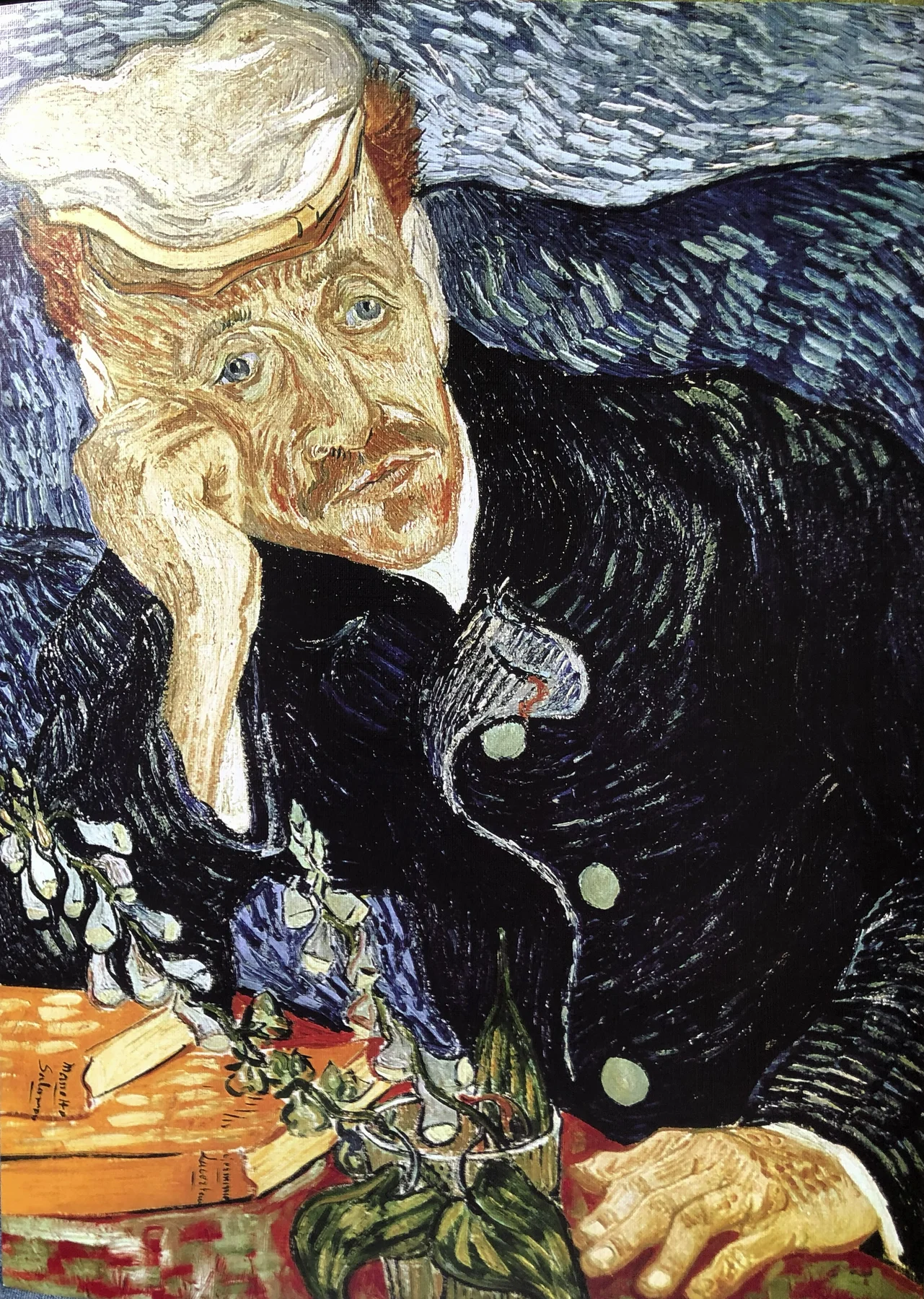
PORTRAIT OF DR GACHET
Vincent van Gogh
- Artist
- Vincent van Gogh (1853–1890)
- Date
- 1890
- Dimensions
- 67 x 56 cm
- Medium
- Oil on canvas
- Location
- Private collection
One of van Gogh’s most famous pictures, Portrait of Dr Gachet depicts a local doctor who treated van Gogh after his arrival in Arles, ten weeks before the artist’s suicide. Dr Gachet could not prevent van Gogh’s tragic death, but he became the artist’s good friend and encouraged him to paint. Despite the doctor’s positive influence and devotion, Gachet appears gloomy and sad in the picture.
The Art Lover
After van Gogh arrived in Auvers-sur-Oise near Paris on 20 May 1890, his first model was Dr Paul-Ferdinand Gachet. The eccentric doctor was kind-natured, and van Gogh’s first impression proved favourable: “I really think we shall remain friends, and I shall do his portrait.” Van Gogh said that Gachet “is devotedly enthusiastic” about his swirling, hallucinatory Self-Portrait made in Saint-Rémy in September 1889, and the art-loving doctor burned with desire to sit for a portrait of his own.
In the short period before van Gogh’s death, Portrait of Dr Gachet was the only male portrait the artist painted in Auvers, although he made two different versions. Van Gogh also made an etching of Gachet, using a needle on a copper plate and the doctor’s own press to print his work L’Homme à la Pipe, and this became the artist’s only attempt at etching. In a letter to his brother Theo in early June 1890 he wrote that he had begun the Portrait of Dr Gachet and enclosed an improvised sketch.
A Record Price
After van Gogh’s death in July 1890, Portrait of Dr Gachet, together with many of the artist’s other works, passed to his brother Theo. Theo was shattered by Vincent’s death, his health deteriorated, and he died shortly afterwards, in early 1891. In 1897 Theo’s widow, Johanna van Gogh-Bonger, sold Portrait of Dr Gachet for 300 francs. A hundred years after van Gogh painted the picture, the doctor’s portrait was bought by a wealthy Japanese businessman for 82.5 million dollars.
In the Storm of History
In the intervening years Portrait of Dr Gachet had a colourful history. In 1937 the Nazis classified van Gogh’s works as “degenerate”, and Portrait of Dr Gachet was removed from the Städel Museum in Frankfurt and then sold at auction by Hermann Göring. In 1938 a Jewish banker, Siegfried Kramarsky, acquired it from a German collector and kept it for more than 50 years, until it was sold at a record price in 1990. The buyer, Ryoei Saito, died in 1996, and the whereabouts of the portrait are currently uncertain.
Blue Swirls
Although van Gogh took his own life barely two months after painting Portrait of Dr Gachet, the artist’s painting is full of confident, powerful brushstrokes, and this final period of van Gogh’s life is marked by enormous achievement. Dr Gachet held van Gogh’s art in high esteem and encouraged the artist’s new techniques. Van Gogh continued to use his colours arbitrarily to express mood, and in this portrait the dominant blue creates a melancholy feeling. The winding black brushstrokes bring out the swirling of the blues, giving structure to the coat, while the shorter, horizontally, vertically and diagonally inserted paler blues and whites visually distort the hills and sky, making them restless.
Blue Sadness
In the painting the doctor wears a worn cream-coloured cap pressed into his spiky red hair and leans pensively on his elbow. Van Gogh clearly did not want to achieve photographic likeness in his portraits, but wanted to paint what he called “apparitions”, which a century later would reveal the sitter’s character thanks to the artist’s “passionate expression”. Colour was the key to expressing mood and “heightening personality”. Blue, the colour of the troubled Gachet’s sad, resigned eyes, is often associated with melancholy. The sky is blue, Gachet’s coat is also blue, and the hills between them are of a strong blue shade too.
Among the swirling blues, evoking a seasick sailor in stormy waves, the doctor drops anchor at the narrow red-and-green piece of table, holding its end with his left hand. Leaning on his elbow, he supports his tired head with his clenched right fist. The foxglove stems are symbols of the homeopathic doctor, who uses foxglove to treat heart disease. The two yellow books on the table are the Goncourt brothers’ Germinie Lacerteux and Manette Salomon, modern novels about the decline of old age. Van Gogh too wanted to paint modern portraits: “Sad, yet gentle, but clear and intelligent — that is how we should paint portraits”.
Masterpiece Connection
In his last months van Gogh showed an extraordinary interest in portraiture and turned to Puvis de Chavannes for inspiration: “As for me, my model of figure painting has always been the portrait of a man by Puvis, in which an old man reads a yellow book, beside him a rose and a brush in a glass of water.” The painting is Eugène Benon (1882), and van Gogh thought the picture “presents modern life as something splendid, despite its inevitable sorrows.”
- Self-Portrait, 1889
- L’Homme à la Pipe
- Hermann Göring