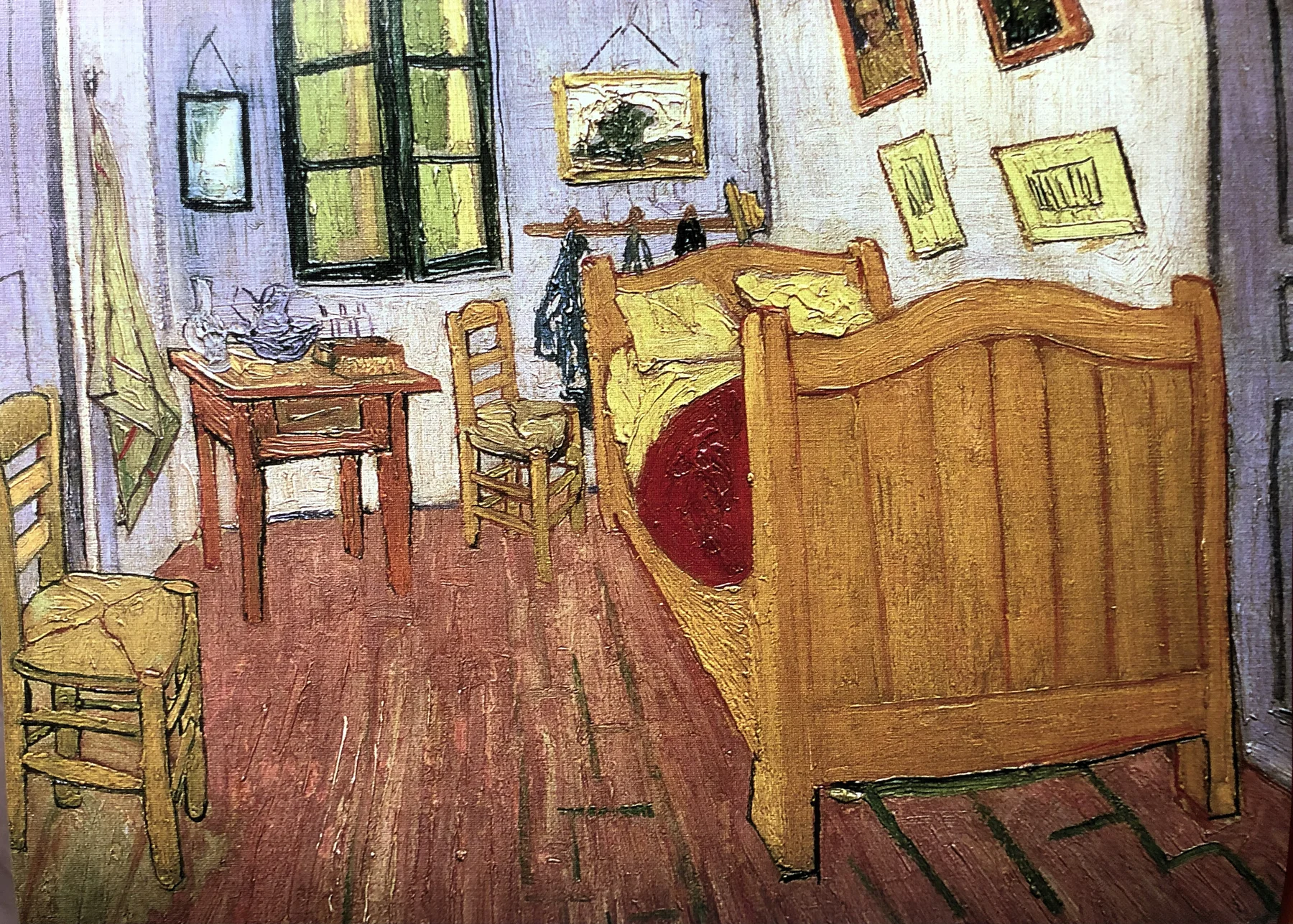
VAN GOGH’S BEDROOM IN ARLES
Vincent van Gogh
- Artist
- Vincent van Gogh (1853–1890)
- Date
- 1888
- Dimensions
- 72 x 90 cm
- Medium
- Oil on canvas
- Location
- Van Gogh Museum, Amsterdam, Netherlands
Seeking peace and brilliant sunshine, Van Gogh spent some 14 months in the town of Arles in the south of France, where he created nearly 200 paintings, including many portraits and landscapes as well as his inimitable sunflower still lifes. He also reported a fresh inspiration in one of his letters to his brother Theo: “I’ve had a new idea… I’m going to paint my bedroom.”
A Place of Rest
On 17 September 1888 Van Gogh moved into the yellow house at 2 Place Lamartine, which he had been using as a studio since May of that year. Van Gogh discovered many new subjects and motifs waiting to be painted, and in early October he told Theo that he had found himself again in his work. Besides his superb series of portraits, such as Eugène Boch (The Poet) and Lieutenant Milliet, his paintings Café Terrace at Night in Arles and The Night Café also reveal a bolder approach.
The artist painted Van Gogh’s Bedroom in Arles in October 1888. No painter before him had tried to depict such a modest interior, but Van Gogh thought his small, cramped bedroom worth recording. The painter did not strive for an exact, photographic reproduction of the room, and, as he explained in one of his letters to his brother, he subordinated everything to colour. Van Gogh presented his bedroom with the wooden bed and two chairs purely through the use of colour, where everything suggests the idea of perfect rest and sleep.
The Best Work
In January 1889, after the painful break with his fellow painter Gauguin, who had lived with him for more than two months, Van Gogh wrote: “When I looked at my canvases again after my illness, the one of my bedroom seemed the best.” The original picture was damaged, and the artist’s brother suggested that Van Gogh make a copy of it. While Van Gogh was recovering in the asylum at Saint-Rémy, he painted two very similar pictures of his bedroom in September 1889. One of them, the same size as the original, is now exhibited at the Art Institute of Chicago. He also made a smaller version, which he gave to his mother and sister. This picture can now be seen in the Musée d'Orsay, while the original of Van Gogh’s Bedroom in Arles enriches the collection of the Van Gogh Museum in Amsterdam.
Colour Combinations
In Van Gogh’s Bedroom in Arles the artist creates a sense of calm through the use of vivid patches created from contrasting colours. He sought to evoke with his use of colour the world of the Japanese prints he so admired. The walls are pale violet, the floor tiles red. The wood of the bed and chairs is fresh butter yellow, the sheets and pillows a very pale lime green. The bedspread is blood red. The window is green. The dressing table is orange, the washbasin blue. The doors are lilac. Each of the colours contributes to creating a peaceful mood. In places the artist applied the paint thickly; his famous impasto technique can be seen most clearly in the raised bands of the floor and on the pale green window shutter.
An Unusual Perspective
Van Gogh depicted the objects with simple forms, placing the emphasis on colour. The bedroom’s two empty chairs and table turn towards the bright yellow bed that dominates the picture, as if in silent conversation with one another.
Although Van Gogh wanted to convey a sense of rest, the painting immediately strikes the viewer with its strange perspective. The lines of the floor and bed run towards an indistinct point, and the back walls stand at an odd angle to the rest of the room. It should be noted, however, that the artist’s bedroom really was unusually shaped, more like a trapezium than a square. In the swirling rush of the floorboards the furniture and other furnishings seem to tilt forward, although Van Gogh deliberately made the pictorial effect flat. He presented the preliminary sketch of the painting to his brother like this: “…you can see how simple the conception is. I suppress the shading and the shadows cast by the objects — I paint flat, plain surfaces, like Japanese prints.”
- Eugène Boch (The Poet)
- The version exhibited in the Musée d'Orsay
- The Van Gogh Museum