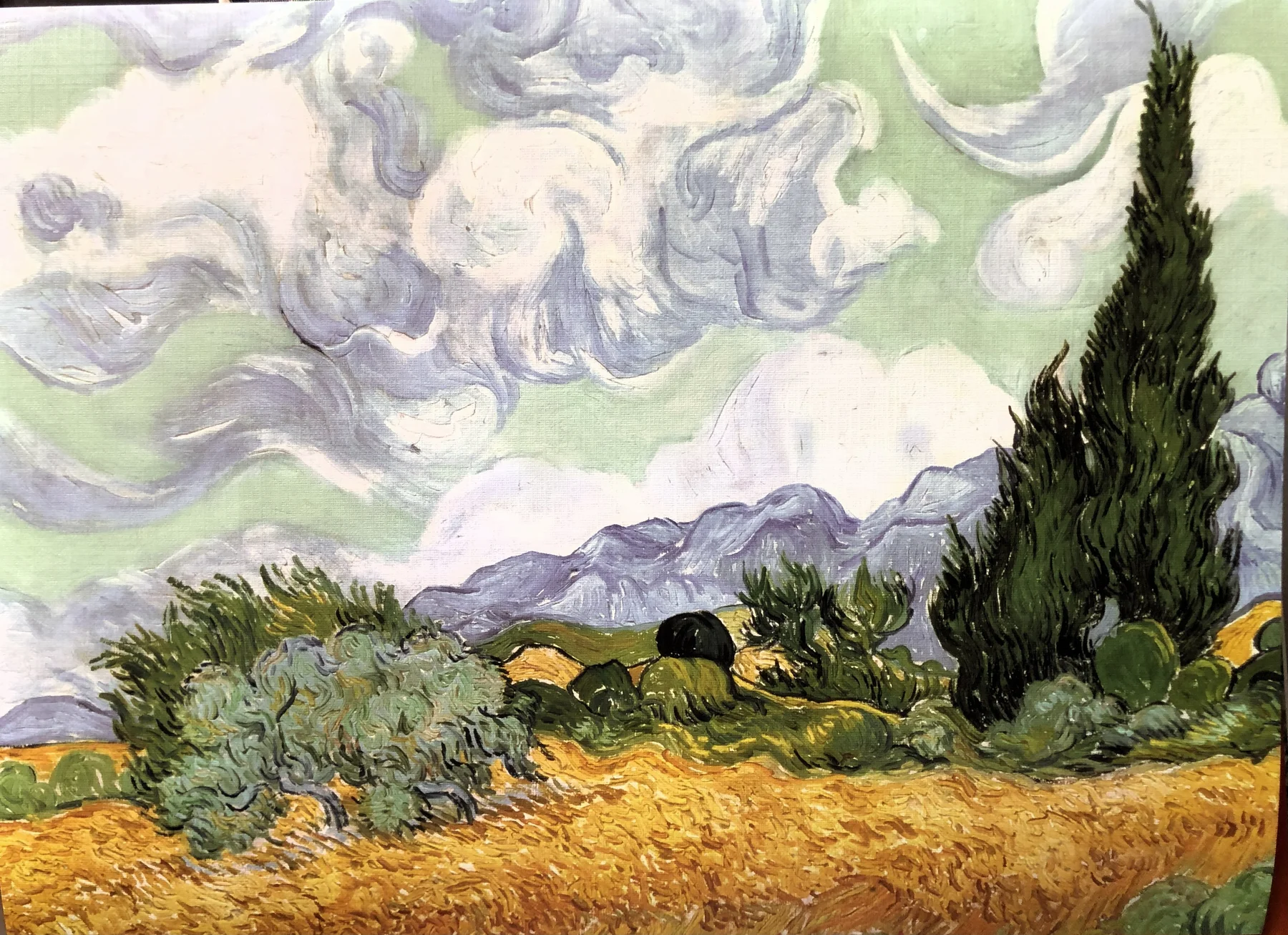
A WHEATFIELD, WITH CYPRESSES
Vincent van Gogh
- Artist
- Vincent van Gogh (1853–1890)
- Date
- 1889
- Dimensions
- 72.1 x 90.9 cm
- Medium
- Oil on canvas
- Location
- National Gallery, London, United Kingdom
One of the most productive periods of Vincent van Gogh’s life was the 12 months he spent at the Saint-Paul-de-Mausole asylum in Saint-Rémy near Arles. Fearing another nervous breakdown, in May 1889 he asked his brother Theo to arrange his admission, because he “could not manage his affairs.” A turbulent but rich creative period began for the artist, during which he painted some 150 canvases, many of which are counted among his most powerful works.
Life in Saint-Rémy
Van Gogh painted the first version of A Wheatfield, with Cypresses in June 1889, when the staff of the institution judged him well enough to leave the hospital grounds. The painting is one of the most powerful landscapes made in this period.
Painting and communing with nature served therapeutic purposes for Van Gogh, helping to occupy his thoughts and keep his bouts of depression at bay. The harder he worked, the healthier and clearer-minded he felt.
Although, in Van Gogh’s words, the Saint-Paul asylum was like a “third-class waiting room”, the staff did everything for his comfort. He was given a separate room as a studio and encouraged to spend as much time as possible in the hospital garden. The plants of the garden inspired many of his paintings, such as the famous Irises (1889).
A Balanced Composition
Although Van Gogh’s landscapes of this time are characterised by dazzling spontaneity, the artist thought their composition through thoroughly. Although A Wheatfield, with Cypresses is built of restless, swirling lines, it is one of the artist’s most balanced works in the classical sense. Van Gogh divides the Provençal landscape into sweeping horizontal bands — wheatfield, hedges and hills, sky — running across the whole width of the picture. The horizontal elements are balanced by the vertical lines of the cypresses towering on the right. Sky and earth occupy the two halves of the canvas in perfect proportion, their duality clearly expressed between the light, soft, rounded forms of the sky and the more characterful depiction and more vivid colours of the earth. The warm and cold colours sit well side by side and seem to merge in the silvery shimmering grey-greens of the olive trees on the left — one of Van Gogh’s favourite natural motifs.
Majestic Cypresses
It is no accident that our gaze is immediately caught by the painting’s imposing cypress trees. Van Gogh was enchanted by cypresses; he once wrote that “their lines and proportions are as beautiful as those of an Egyptian obelisk.” He was captivated by their contrast with the rolling hills of the serene Provençal landscape, but they also posed an artistic challenge: “Black patches in a sunlit landscape, but of the most interesting kind, which I can imagine nothing harder to render.” A Wheatfield, with Cypresses was one of the pieces in Van Gogh’s series of landscapes painted in Saint-Rémy.
Van Gogh’s cypresses always shimmer vividly and colourfully, but there is something ominous in them that reflects his troubled state of mind. This is especially true of his more Expressionist paintings, such as The Starry Night (1889) and Road with Cypress and Star (1890), where the trees tower huge and terrifying, like shadows of death. In A Wheatfield, with Cypresses the trees appear almost as a religious symbol, spectacularly linking the earth with “heaven”.
A Symbolic Sky
Van Gogh is famous for his dramatically swirling skies, and accordingly in this picture too it is mainly the sky that reflects the artist’s turbulent emotions. During his stay in Saint-Rémy Van Gogh’s mental state improved several times. A Wheatfield, with Cypresses was made in one such period of calm, and although he filled the sky with fierce energy, here it creates an invigorating rather than threatening effect. The warm blue, violet, grey and greenish tones pervading the landscape express the perfect harmony of nature.
The Cycle of Life
Raised in a rural setting, Van Gogh was always drawn to country landscapes. He painted several idyllic pictures of “peasant life” and was particularly fascinated by wheatfields, which he captured in every season of the year, from ploughing and sowing to ripening and harvest, rendered in his favourite golden yellow. For Van Gogh the wheatfield symbolised the cycle of life. This theme also appears in what is thought to be his last painting, Wheatfield with Crows (1890), which he described as “a vast wheatfield under a troubled sky.” Shortly after painting this scene, in July 1890, Van Gogh walked out into a wheatfield and shot himself.
After his death A Wheatfield, with Cypresses was bought by the French critic Octave Mirbeau, who sold it to the Courtauld Foundation in 1923. In 1961 the painting moved from the Tate Gallery in London to its present home, the National Gallery in London.
- The Saint-Paul-de-Mausole asylum in Saint-Rémy
- Van Gogh: Road with Cypress and Star (1890)
- National Gallery, London, United Kingdom
- Van Gogh: Self-Portrait, 1889