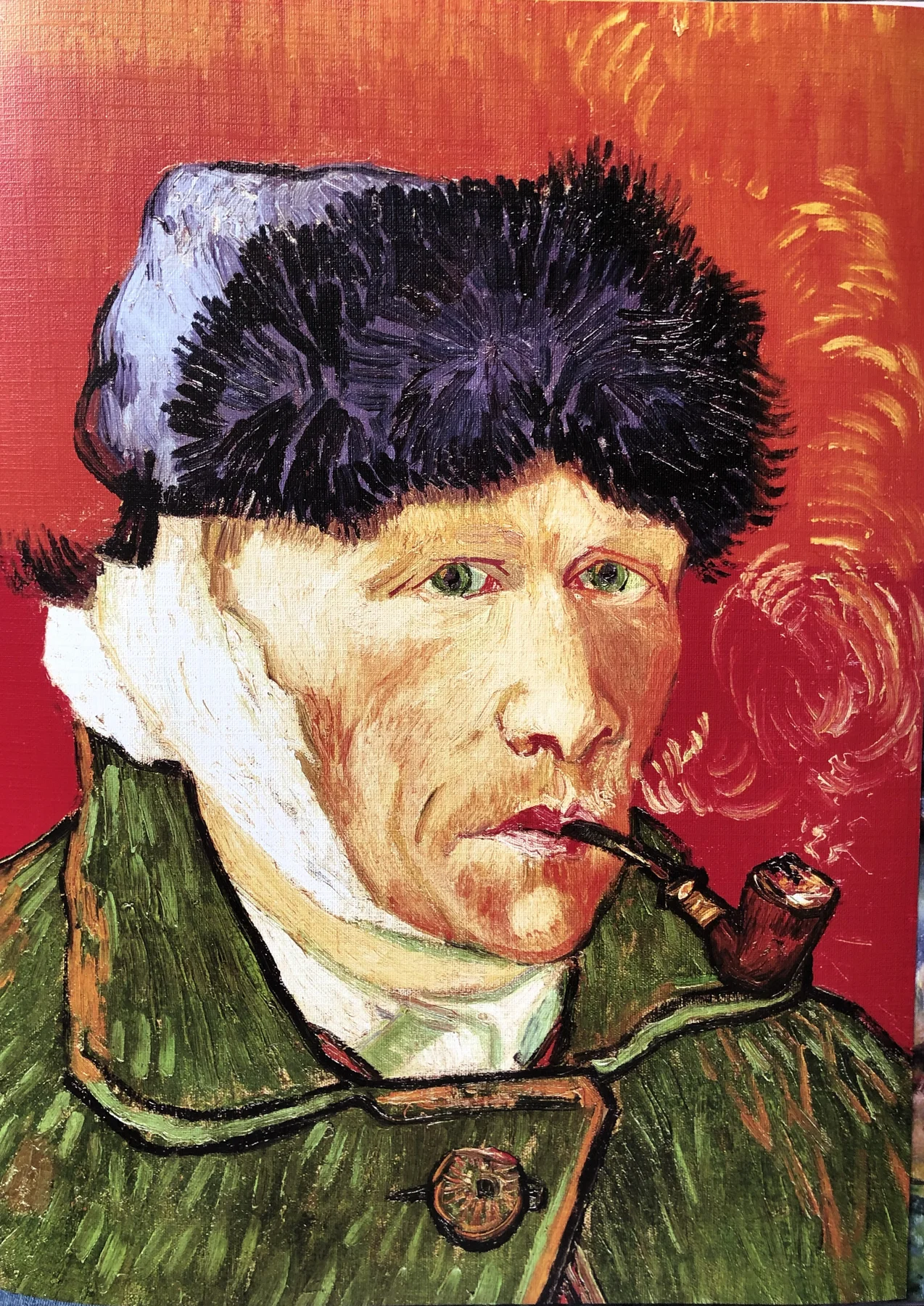
SELF-PORTRAIT WITH BANDAGED EAR AND PIPE
Vincent van Gogh
- Artist
- Vincent Willem van Gogh (1853–1890)
- Date
- 1889
- Dimensions
- 51 x 45 cm
- Medium
- Oil on canvas
- Location
- Private collection (Niarchos collection)
Van Gogh’s self-portraits are manifestations of his inner struggles, revealing much about the painter and the man himself at different stages of his artistic career. In his earlier paintings the use of yellow may on the one hand symbolise the onset of a happier, brighter period, and on the other his handling of colour can be interpreted as experimentation with form. Self-Portrait with Bandaged Ear and Pipe was made towards the end of the artist’s short, tragic life, and Van Gogh’s troubled state of mind can be clearly seen in it.
The Severed Ear
Self-Portrait with Bandaged Ear and Pipe is one of two self-portraits the Dutch artist painted in January 1889. Both works depict Van Gogh with a bandaged ear after the well-known episode of his life in which he lost a piece of his left earlobe. When he painted Self-Portrait with Bandaged Ear and Pipe, Van Gogh had already recovered and was again living in the Yellow House, where he recorded his injury in two paintings.
A Dispute about “Art”
In his ultimately fateful attempt to create an artists’ colony in Arles in the south of France, Van Gogh invited his fellow painter Gauguin to stay with him in October 1888. The two strong personalities clashed for two months but could not find common ground in their conception of “Art” — Van Gogh favoured Romanticism, Gauguin primitive art. After a drunken quarrel on 23 December 1888, Gauguin threatened to leave Arles. According to Gauguin, the deranged Van Gogh attacked him with a razor, so he fled and spent the night in a hotel room. Van Gogh went to the nearby brothel and handed his severed earlobe, wrapped in newspaper, to a prostitute named Rachel with the words: “Keep this as a souvenir of me.”
Accomplices?
This version of events is accepted as true by almost everyone, although there is no eyewitness account of what happened, and contradictory evidence has emerged regarding the actual incident. Two German art historians, Hans Kaufmann and Rita Wildegans, re-examined the evidence over more than ten years of research, including the artist’s correspondence and contemporary police reports. In their book Van Gogh’s Ear: Paul Gauguin and the Pact of Silence they put forward the theory that the two artists quarrelled and that Gauguin, an excellent fencer, cut off a piece of Van Gogh’s ear with a sword. Van Gogh thus took responsibility for the injury, since both testified to self-mutilation at the police station. Van Gogh was taken to hospital because of blood loss, and Gauguin travelled to Paris.
Subtleties of Expression
What first strikes us on seeing Self-Portrait with Bandaged Ear and Pipe is the painting’s vivid colour scheme, especially the bands of the red and yellow background. Van Gogh conveys the texture of his fur cap with boldly simple patches of blue, black and white paint. On the roughly painted green winter coat with black outlines the downward brushstrokes are clearly visible, with blue and light brown tones indicating the highlights. Van Gogh evidently devoted most attention to working out the pipe and especially to the expressive depiction of the sad green eyes looking out of the portrait. With extremely fine brushstrokes he outlines the irises in black, while in the green of the eyes fine white touches convey the reflected light.
A Wounded Animal
In the two self-portraits painted in January 1889 Van Gogh depicts himself with a bandage on his head, adopting a similar pose in both and wearing the same coat and cap. He captured the subject differently in the two pictures, however: in the version without the pipe, Self-Portrait with Bandaged Ear, he painted himself with a more reserved and indifferent expression. In his portraits Van Gogh attached great importance to eye contact with his sitters, and on this basis Self-Portrait with Bandaged Ear and Pipe is the more intimate picture: a piercing eye, a penetrating gaze looks back from the mirror, from which the viewer can try to read the artist’s feelings and thoughts. As a sign of low self-esteem he draws his neck down between his shoulders, giving the impression of a wounded animal begging for sympathy, love and, perhaps most importantly, understanding.
A Mysterious Attack
If Van Gogh did indeed cut off his own earlobe, this moving self-portrait testifies that he wanted to arouse the sympathy of others for his suffering and his act. If Gauguin was the perpetrator, Van Gogh’s Self-Portrait with Bandaged Ear and Pipe still presents a man who wants to win the viewer’s sympathy, but in this case the picture is somewhat enigmatic. Did the artist try to cover for his friend with his silence? It is unlikely that we will ever know the whole truth about Van Gogh and Gauguin’s final quarrel, but it was the last time the two artists saw each other.
Part of a Private Collection
Van Gogh’s Self-Portrait with Bandaged Ear and Pipe once belonged to the wealthy Chicago industrialist Leigh B. Block. The painting was later bought by the Niarchos family for an undisclosed sum. The late Greek shipping magnate Stavros Niarchos enriched his collection mainly in the 1950s; his heirs today boast one of the most famous private collections in the world.
- Van Gogh: The Yellow House, 1888
- Van Gogh: Self-Portrait with Bandaged Ear