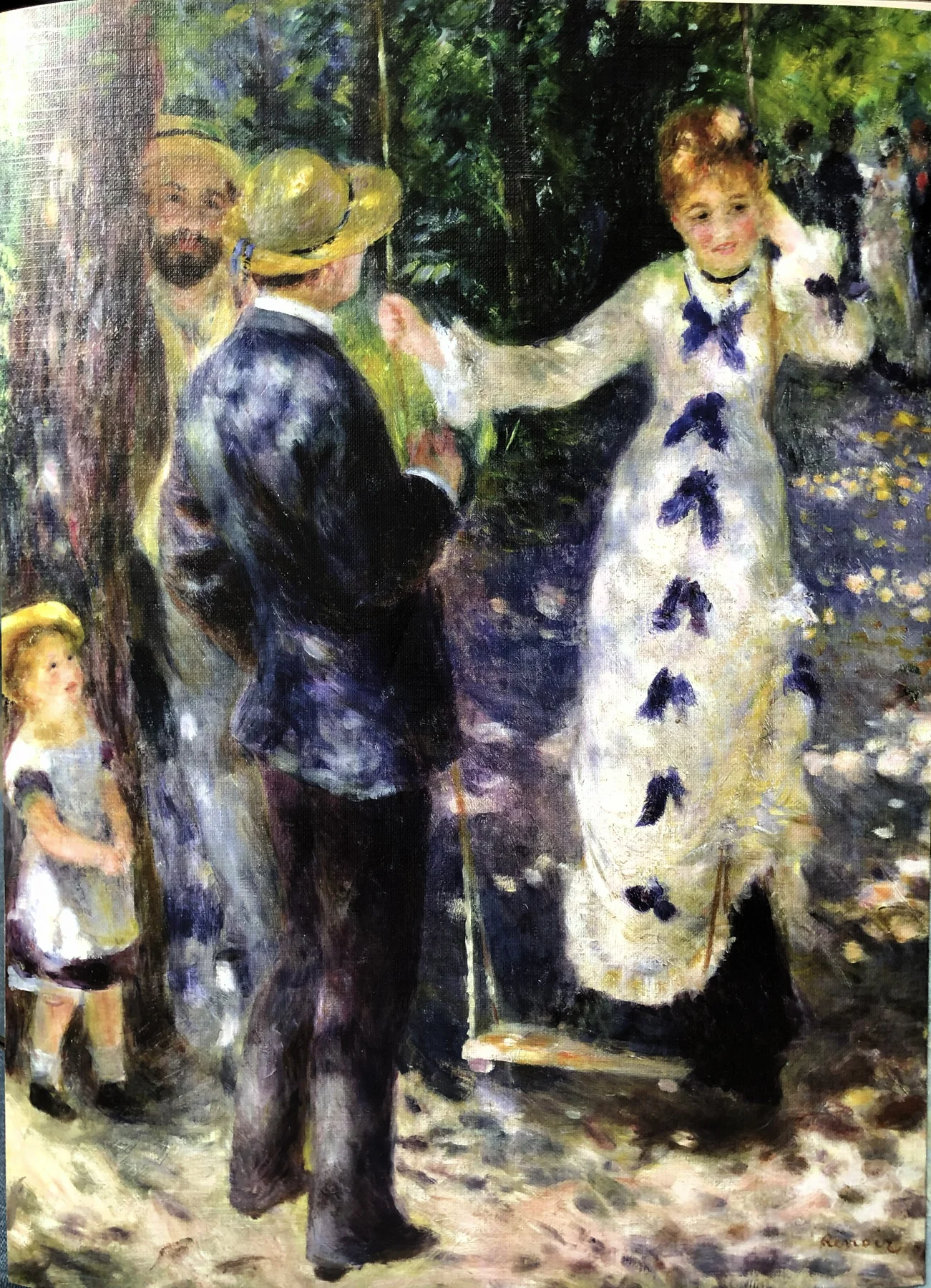
THE SWING
Pierre-Auguste Renoir
- Artist
- Auguste Renoir (1841–1919)
- Date
- 1876
- Dimensions
- 92 x 73 cm
- Medium
- Oil on canvas
- Location
- Musée d'Orsay, Paris, France
Renoir’s The Swing was made in 1876, the same year as Dance at the Moulin de la Gallette, one of his early Impressionist masterpieces. The Swing, like the larger composition of the Parisian dance hall, radiates momentum and touches the viewer of the painting above all with its refreshing lightness. Renoir was particularly interested in depicting the play of sunlight on the ground and on his models’ faces and clothes. He had an unparalleled talent for preserving the fleeting moment and capturing the happy, carefree mood of a summer day, as we can see in this picture.
Morning Sunshine
In the summer of 1876 Renoir rented part of a house that had seen better days on the rue Cortot in Montmartre, Paris. Although The Swing seems to depict a sunny rural setting, it was probably made in the somewhat overgrown garden of Renoir’s rented Paris home. The location was convenient for Renoir, since in the summer of 1876 the painter was painting Dance at the Moulin de la Gallette, and the popular open-air dance hall was just around the corner. Renoir often worked in his rue Cortot studio, painting The Swing in the morning and the more challenging Dance at the Moulin de la Gallette in the afternoon.
Paris Forever
The Swing was shown at the Third Impressionist Exhibition in 1877, where it irritated many critics. One of them called the light effects “grease spots on the models’ clothes!” The collector and artist Gustave Caillebotte, however, appreciated it and bought it that same year together with Dance at the Moulin de la Gallette. Caillebotte then bequeathed The Swing to the French state in 1894. Apart from occasional touring exhibitions, The Swing has always remained in Paris. From 1929 the painting was exhibited in the collection of the famous Paris art museum, the Louvre, and in 1986 it was moved to its present location, the Musée d'Orsay.
A Dappled Effect
Since The Swing was made practically in parallel with Dance at the Moulin de la Gallette in the summer of 1876, there are obviously some similarities in their technique. At this time Renoir was experimenting with capturing strong natural light under the canopy of trees. With delicate, almost feather-light brushstrokes the artist depicts the distorting, bleaching effect of strong sunlight, contrasting it with darker patches of blue and brown areas, to show the light filtering unevenly through the foliage of the trees in the natural setting of the garden.
Dissolving in Sunlight
In The Swing the bearded man stands in the shade of the tree, and although his features are well worked out, the painter was sparing with his brushstrokes. The woman’s features, on the other hand, are less distinct, since sunlight falls on her face. Although the child’s face and body are painted rather sketchily, her figure is clearly discernible as she patiently watches the young man talking to the woman on the swing.
Renoir also nicely highlights a few details in the picture — such as the bold white brushstroke on the back of the man’s collar, the yellow halo of the child’s straw hat, or the beautifully glinting light on the young woman’s red hair.
The Centre of Attention
The Swing gives the impression of having been painted on the spot, from life, in a sunny outdoor setting. Renoir created an eye-pleasing composition with interesting dynamics between the four people in the foreground. The obvious centre of the painting is the woman on the swing. On the left of the picture three figures can be seen, including two men leaning very close to each other. The bearded man looks out from behind a tree and intently watches the man talking to the woman. The child watches him too. Meanwhile the woman, judging by her slightly flushed face, downcast eyes and awkward posture, draws away from the man as far as possible; she stays on the swing but is embarrassed by the gaze fixed on her. The relationship between the three adults in the foreground remains hidden in the picture. We can infer many things, but the painter does not reveal the specific emotions, whether love, jealousy or even a budding flirtation. The positions of the figures are also somewhat surprising: we would rather imagine the little girl on the swing, but she only waits peacefully.
Masterpiece Connection
In 1862 Renoir began a deep friendship with his fellow student Claude Monet, who also studied at Charles Gleyre’s art school. In 1869 Renoir spent the summer with his parents in Louveciennes and travelled up the river almost every day to visit his friend Monet in Bougival. Both artists painted the well-known, beautiful spot La Grenouillère (Frog Pond) from a similar viewpoint (pictured below, Renoir above and Monet below). At that time their styles became quite similar — so much so that years later neither artist could remember which of them had painted the unsigned pictures.
- Dance at the Moulin de la Gallette