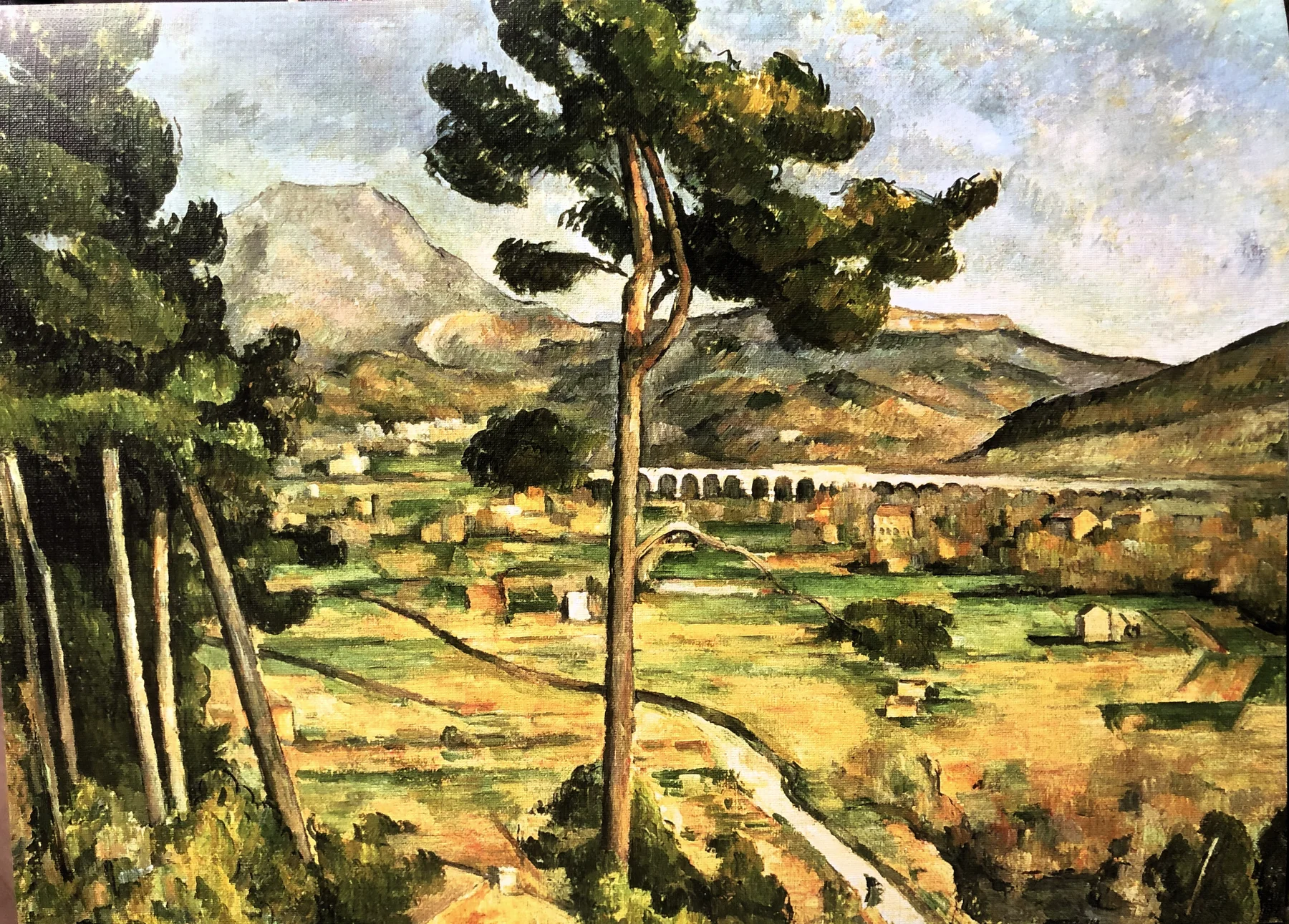
MONT SAINTE-VICTOIRE
Paul Cézanne
- Artist
- Paul Cézanne (1839–1906)
- Date
- Between 1882 and 1885
- Dimensions
- 65.5 x 81.5 cm
- Medium
- Oil on canvas
- Location
- The Metropolitan Museum of Art, New York, USA
Henri Matisse once called Cézanne the god of painting; the painter from Provence in France has since been regarded as the father of modern art. Cézanne undoubtedly had a great influence on the development of early-20th-century painting. His work served as a link between Impressionism and Cubism. Cézanne painted many landscapes, but one subject excited him most: Mont Sainte-Victoire, which he captured in all its splendour and majesty from every possible angle. The mountain completely enchanted him. His panoramic pictures of it are among the best-known works in the history of landscape painting.
Provence, His Homeland
When Paul Cézanne returned to his native Provence in the 1880s, he rediscovered the beloved landscape. The view of his home town, Aix-en-Provence, and its surroundings is dominated by the almost thousand-metre peak of the imposing, cone-like Mont Sainte-Victoire. “Here I find only the simple, raw and majestic beauty of our Provence,” said Cézanne, and in his landscapes he recorded above all the majestic mountain.
Cézanne first depicted Mont Sainte-Victoire in his painting The Railway Cutting, made around 1869, but he returned several times to the motif, which occupied him until the end of his life. Sometime between 1882 and 1885 he painted Mont Sainte-Victoire seen from Bellevue, the first piece of his series on the mountain made between 1882 and 1890. In the last years of his life he also made a second series of more than 30 oil paintings and 45 watercolours on the subject, from many different viewpoints and angles.
A Generous Donation
Around 1901 the famous French collector Ambroise Vollard (1866–1939), an enthusiastic supporter of Cézanne’s works, sold the picture to a wealthy New York couple, Mr and Mrs Henry Osborne Havemeyer. Mr Havemeyer and his wife, Louisine, were probably persuaded to buy the work by their friend, the American Impressionist painter Mary Cassatt (1844–1926). The purchase price of 15,000 francs was rather high, but Mr Havemeyer was enchanted by Cézanne’s painting and spoke of the picture with great appreciation. In 1929 Mrs H. O. Havemeyer bequeathed Mont Sainte-Victoire — together with nearly two thousand other works of art — to the Metropolitan Museum in New York.
Short Brushstrokes
The majestic peak of Mont Sainte-Victoire offered itself as an ideal natural motif for Cézanne’s brush. In depicting this huge symbol of the ancient Provençal landscape the artist painted at his usual slow pace; the picture, methodically built up from patches of colour, suggests an almost engineered unity. Of all the paintings he made on the subject over more than twenty years, Mont Sainte-Victoire seen from Bellevue is the most detailed and most worked-out; the short, firm brushstrokes bring the whole canvas to life. Although he deliberately made the picture flat, so that we feel the distant monumental mountain in the background to be closer, Cézanne presents a breathtaking and at the same time peaceful panoramic view.
A Fine View of the Valley
In his later painting Mont Sainte-Victoire with Large Pine, made around 1887, the mountain is placed at the centre of the canvas, while the branches of the pine tree on the left follow and at the same time frame the untouched ridge of Mont Sainte-Victoire. In Mont Sainte-Victoire seen from Bellevue, by contrast, the pink-tinged peak is moved further out of the picture’s focus. Cézanne painted a group of five pine trees on the left of the composition, and the centre of the canvas is occupied by a solitary pine. The firm vertical line of the trunk is balanced by the horizontally running viaduct spanning the valley of the River Arc, the scattered colour groups of the field, the undulating ridge of Le Cengle and the peak itself.
- The Railway Cutting
- Mrs Havemeyer
- View of Mont Sainte-Victoire with Large Pine
- Mont Sainte-Victoire today