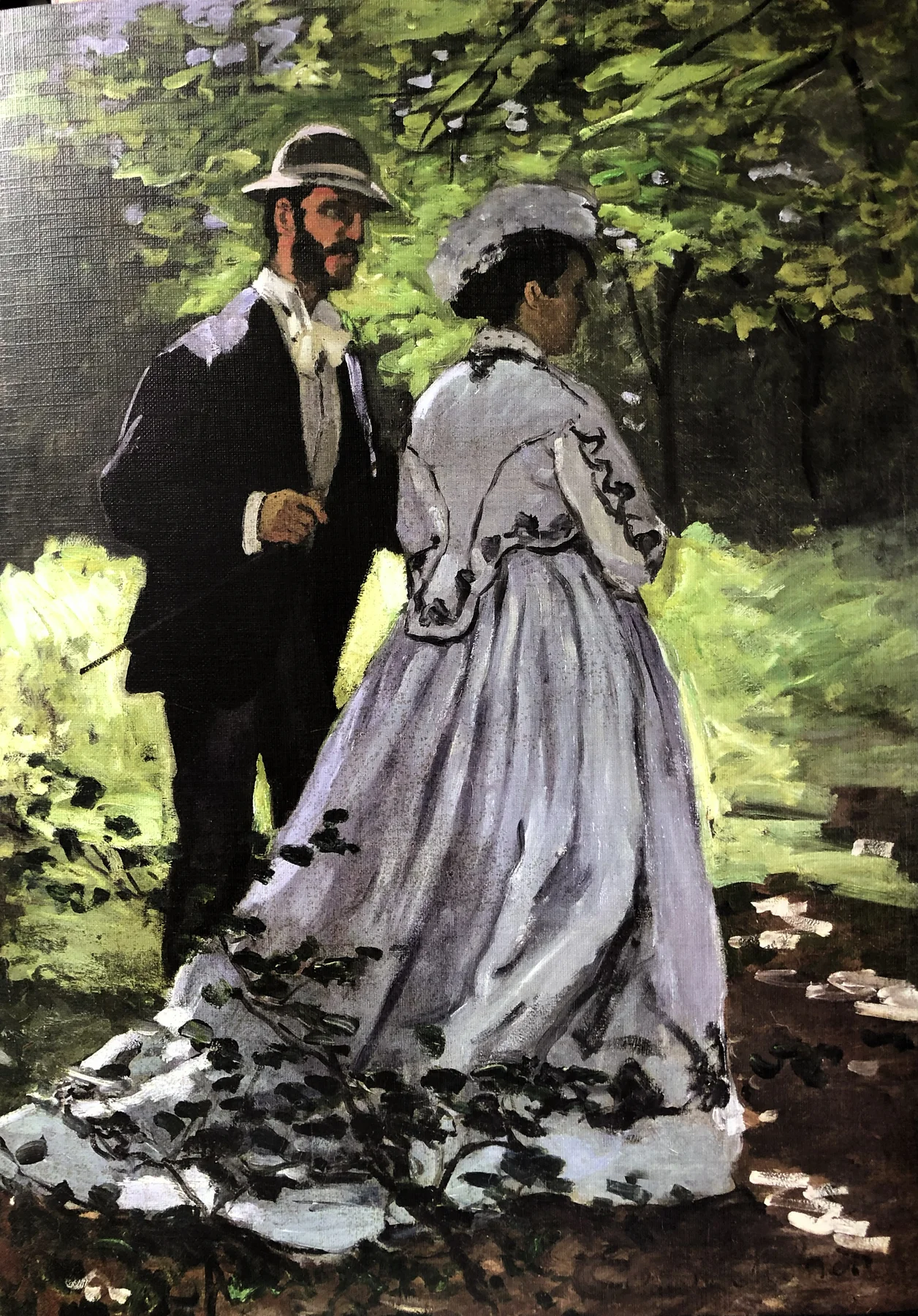
BAZILLE AND CAMILLE (STUDY FOR “LUNCHEON ON THE GRASS”)
Claude Monet
- Artist
- Claude Monet (1840–1926)
- Date
- 1865
- Dimensions
- 93 x 68.9 cm
- Medium
- Oil on canvas
- Location
- National Gallery of Art, Washington, D.C., United States
Knowing how popular Monet became in old age, it is easy to forget that in his younger years his inexperience and ambition once got the better of him. As a sensitive young man of twenty-five he set about painting a huge picture to dazzle the Salon jury, win glory among his role models and fellow painters, and launch his career. But he never finished the work. All we can see of it are preliminary studies, including this walking couple, for which the painter’s future wife and his best friend modelled.
Monet: Manet’s Man
Monet learned to paint in the realist style of Eugène Boudin and Gustave Courbet, but in the early 1860s he was captivated by Édouard Manet, the emerging talent. Manet had scandalised Paris with his picture Luncheon on the Grass. The work caused outrage not only because it depicted a naked woman sitting between two well-dressed gentlemen, but also because of the way it was painted. Manet’s bold brushwork lacked the fine brushstrokes favoured by the Salon jury. With his painting technique he achieved surprising contrasts and created flatness. The picture was made in the studio, so it seemed particularly artificial.
The Salon rejected the radical painting. When Monet saw it at the Salon des Refusés, the exhibition of the rejected, he was stunned, and he later called this moment his “road to Damascus”. After the Salon accepted only a few seaside scenes, Monet felt the time had come to take a big step forward. He would paint a Luncheon on the Grass, but in his own style. Monet wanted not only to pay homage to Manet but to surpass him: his painting would be bigger and more real.
Super-Realist
First of all he chose a canvas about 450 x 600 cm. He was inspired by the genre of huge Salon paintings known by the French as machines, and especially by Courbet’s A Burial at Ornans (1849–50). Machines usually depicted heroic or historical scenes, but Courbet — the last realist — painted his great-uncle’s funeral; his models were the mourners.
Monet likewise chose an everyday subject: a bourgeois Sunday picnic in the forest, and he asked Frédéric Bazille and Camille Doncieux to model. (Although Monet was reluctant about figure painting, he felt he had to paint people into a painting to please the Salon jury.)
Into the Forest
Painting Luncheon on the Grass and making the sketches and studies occupied Monet for a year. Like this detail study, he also painted a huge (larger than 120 x 180 cm) oil study of the whole composition, now in Moscow.
In early April 1865 Monet went to Chailly-en-Bière, near the Forest of Fontainebleau. He worked on the forest scene for three months, then persuaded Bazille to visit him at the end of the summer and model for the male figures. Camille was probably the model for the female figures, since the dresses reappear in Monet’s painting Women in the Garden, made in 1867 (for which Camille modelled all three female figures).
A Landscape Painter at Heart
What is most enchanting about Bazille and Camille is the special importance it gives to the landscape. Although the background has evidently been worked out hastily, the vivid greens and browns outshine the figures, and the way Monet captures the sunlight filtering through the foliage already foreshadows his lifelong passion for light and nature. By contrast, the two figures stand in shadow. Although this picture is a study for a larger work, Monet composed it carefully: the diagonal of Bazille’s walking stick is echoed in the line of the branches in the upper right corner, balanced by the foliage in the lower left corner.
Magnified Problems
By November Monet had returned to Paris to begin the machine. Enlarging the main study, however, required enormous energy, and it proved difficult to transfer the naturalness of the dappled light to the huge canvas; the life-size figures were awkward in the unworked, flat surroundings. He missed the Salon deadline, ran out of time and money, so he stopped painting the picture and rolled it up to continue later.
Monet never sent another picture to the Salon… and perhaps that was just as well. As he mused in an interview in 1920: “If I had shown it at the Salon and they had accepted it, who knows, perhaps my career would have turned out differently.”
- Luncheon on the Grass – large sketch, now in the Pushkin Museum in Moscow
- Frédéric Bazille
- Luncheon on the Grass, Manet’s painting
- Courbet’s painting, A Burial at Ornans
- Monet: Woman in the Garden