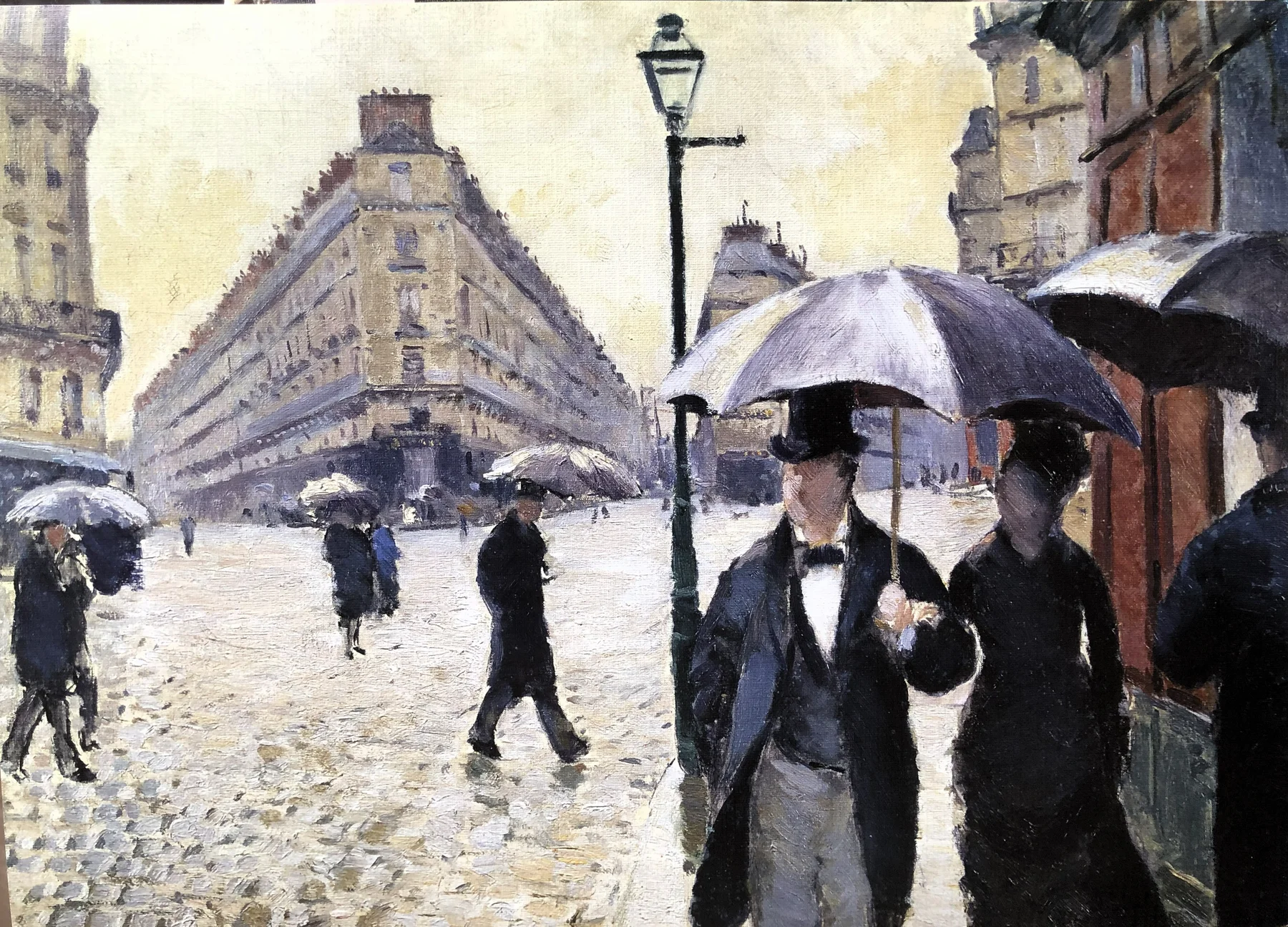
PARIS STREET; RAINY DAY
Gustave Caillebotte
- Artist
- Gustave Caillebotte (1848–1894)
- Date
- 1877
- Dimensions
- 212.2 x 276.2 cm
- Medium
- Oil on canvas
- Location
- The Art Institute of Chicago, Illinois
In his choice of subject and composition Gustave Caillebotte was a true Impressionist, but he did not adopt, for example, the looser brushstrokes of Renoir and Monet. The Impressionists rejected history painting and depicted instead the present world of everyday life. These paintings were worth little to a patron of the previous century, who thought it pointless to record ordinary people walking along a city street. Paris Street; Rainy Day is a captivating snapshot of the modern lifestyle. At the end of the 19th century Paris was the centre of the art world and soon began to be called the “city of light”. The streets shown in the painting were around the Gare Saint-Lazare; scenes of trains and day trips often appear in Impressionist works. At that time the world’s first department stores opened, and people discovered the pleasures of shopping and luxury goods. In the painting we see ordinary women and men walking along characteristic Parisian boulevards, holding umbrellas with metal frames, then a novelty. Apparently nothing happens in the picture, but nothing is what it seems.
Presenting the New Paris
The 1870s were a special period in the history of Paris. The complete transformation of the city was entering its third decade, and the new cityscape is the protagonist of this scene. The Impressionists presented everyday life and the grand urban construction works with great zeal. As one of the well-to-do painters, Caillebotte did not have to worry about selling his pictures: he was free to decide what he wanted to paint.
A Key Figure of the Impressionists
Caillebotte was born into a wealthy family in 1848, the year of the European revolutions. He trained as a lawyer, but after coming into a considerable inheritance he decided to become a painter and enrolled at the École des Beaux-Arts in Paris, where he made friends with other art students receptive to depicting the new world, including Renoir, Degas and Monet. Caillebotte was an excellent painter and a good observer who made his works with meticulous care, but in terms of fame, talent and artistic influence he did not reach the level of his friends. He nevertheless played a key role in the Impressionist movement: he organised exhibitions and, through his connections, supported the group’s activities financially, directly and indirectly.
Rebuilding Paris
The Paris we know is surprisingly new. In 1852 Emperor Napoleon III commissioned Baron Georges Haussmann to launch large-scale urban public works programmes. The old, medieval-style winding narrow streets and bustling districts of Paris were wiped off the face of the earth: the city was rebuilt. The plans served not only to modernise Paris but also to cleanse the city of radical elements. The most striking result of the works was the creation of the famous Parisian boulevards, too wide for revolutionary barricades but straight and broad enough for cannon fire and the assembly of military units. An incredible transformation began: a new water and sewer system was laid, the city got new street lighting (one of the key elements of this painting), almost a quarter of the streets were renewed, parks were created and a transport network built. Paris became a spectacle.
Many Impressionists thought Paris had been stripped of its character. The houses and streets were built to a single pattern, Haussmann’s gaping boulevards broke up traditional communities and separated people from one another. All this appears in the painting too. Everything is grey, no one speaks to anyone, and the scaffolding visible in the distance recalls the unceasing work of reconstruction.
A Photographic Approach
The spontaneous magic of photography had a great influence on the Impressionist style, which Paris Street; Rainy Day illustrates perfectly. We feel as if we were looking at a scene captured by a curious camera: the eye level matches that of the people approaching us, which is why we do not see the lower part of the legs of the couple walking in the foreground.
The longer we look at the painting, the more we discover the structural elements of the composition. The lamp post and its shadow, for example, cut the picture vertically in two, and the groups of people walking the cobbled street form a triangle on the left that mirrors the shape of the building towering behind them. Caillebotte’s masterpiece is a perfect imprint of a slice of Parisian life.
Late Fame
Caillebotte organised many Impressionist exhibitions, including the 1877 show at which the public first saw Paris Street; Rainy Day. The huge canvas, almost 2 x 3 metres, attracted attention in itself and dominated the exhibition. The painting remained in the Caillebotte family for decades: after Gustave’s death in 1894 it passed to his brother and then to various relatives.
After the painter’s death the picture was shown at a retrospective exhibition and then disappeared from public view until 1951. In 1954 it was bought by Walter P. Chrysler Jr., son of the famous car designer and one of the greatest American collectors. (Chrysler Jr. bought a small Renoir watercolour of a nude with the money he received for his 14th birthday, but one of his teachers was so scandalised by the naked woman that he destroyed the work!) In 1964 Chrysler sold the painting to the well-known New York art dealers Wildenstein & Company, but the picture did not stay long in the firm’s possession: that same year it was acquired by one of the most famous art galleries in the United States, the Art Institute of Chicago. The purchase price was not made public; in any case the acquisition of the work was considered a bold step for the institution. Caillebotte’s art was then largely undiscovered, since he was regarded more as a patron of the Impressionists than as a painter. Today Caillebotte enjoys a good reputation, and Paris Street; Rainy Day is an outstanding attraction of the Chicago gallery.
- Paris under reconstruction
- The painting on display at the Art Institute of Chicago
- Adolphe Yvon: Napoleon III Handing Over the Decree for the Rebuilding of Paris