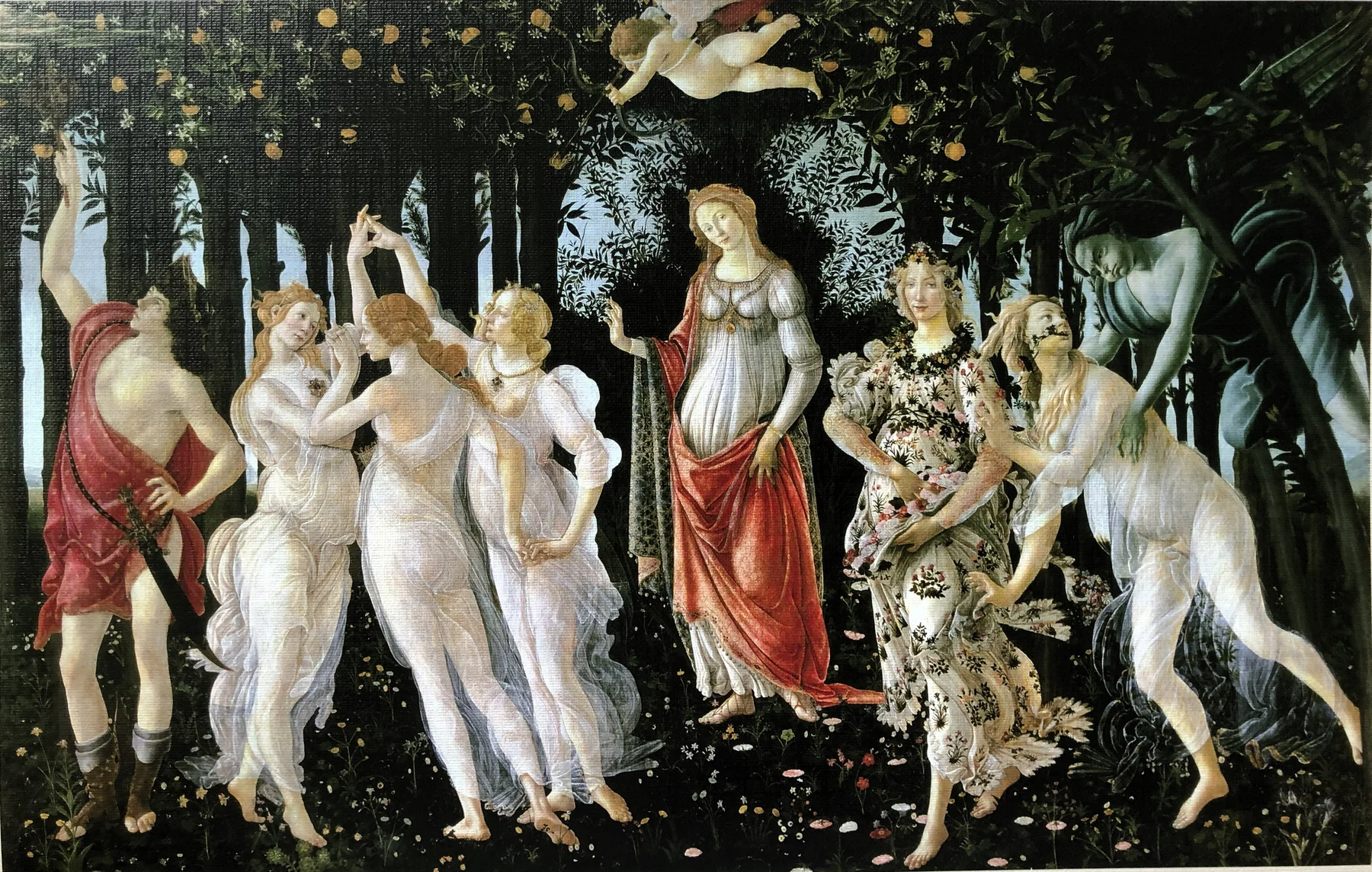
SPRING (PRIMAVERA)
Sandro Botticelli
- Artist
- Sandro Botticelli (c. 1444/45–1510)
- Date
- c. 1478
- Dimensions
- 315 x 203 cm
- Medium
- Tempera on panel
- Location
- Uffizi Gallery, Florence, Italy
The enchanting picture Spring comes from an era when religious works set the standard. Spring is one of the most wonderful paintings of all time, the deification of a pagan subject through visual poetry. It was one of the first large-scale works on a mythological subject in a period dominated by religious works, and also the largest. The picture is the highest synthesis of classical and contemporary art, a mythological scene that still speaks to us centuries after it was painted.
A Wonderful Mystery
The mystique and enigma surrounding the painting stem partly from the fact that, despite its fame, we know little about its meaning and history. Over the past 150 years art historians have debated its interpretation at length, but the mystery will never be solved. The age of the rebirth and flowering of Western culture was shaped by various influences, from the popular philosophical teaching of Neoplatonism to Dante’s Divine Comedy. Botticelli was an enthusiastic admirer of Dante and also made illustrations for the poet’s main work. One of the most popular theories derives Spring from the festivals of the Roman calendar recorded by Ovid. The simplest interpretation is that the painting is about love, the coming of spring and the rebirth of nature. It was supposedly intended as a wedding present — the picture’s many fertility symbols allude to the hope of a marriage richly blessed with children.
Taking Ovid’s story as a basis, the main figure of the picture is Venus, surrounded by flowers, goddess of love and beauty, protector of the institution of marriage. To her left the three Graces dance — grace and elegance played an important role in Florentine society — but the Graces were also associated with marriage and fertility. On the right of the picture is Zephyrus, god of the winds, who turns aggressively towards the nymph Chloris. He abducts the young girl, but his crime prompts the gods to transform Chloris into Flora, goddess of spring, the female figure beside the terrified nymph, who accordingly appears twice in the picture. The blindfolded Cupid aims his famous bow and arrows at the Graces. The figure standing on the far left is Mercury, protector of gardens, who touches the clouds to send rain upon nature and thus bring abundance. The scene presents the cycle of love and life.
The picture perfectly conveys Botticelli’s style. Spring, this unparalleled depiction of female beauty, presents various female figures in flowing dresses; the artist captures their graceful movements in a special style that may seem a little strange if we examine the picture more closely. The lines are perhaps too rounded and unusually elongated, but none of this matters, because the beauty of the female figures captivates the viewer.
Lost and Found
Opinions largely agree that the picture was commissioned by the famous Medici family, since at that time they were the most famous patrons in Florence, and perhaps in the whole world. This view is supported by a 1498 inventory of the household of Lorenzo di Pierfrancesco de’ Medici, which lists two works by Botticelli, the paintings depicting the Birth of Venus and Spring (the latter got its title only later). The painting was kept hidden from the public, and until 1743, when the Medici family died out, only a privileged few could see it. The forgotten work was then kept in a storeroom of the Uffizi palace and was not exhibited until 1853. The public showing caused a sensation: Spring was regarded as a lost masterpiece of the Renaissance, and with the exhibited work Botticelli was rediscovered as a great artist. The painting was restored in 1982, during which its brilliant colours reappeared.
The Medici Family
When speaking of Renaissance art and its history, the Medici must definitely be mentioned. Originally a family of bankers and merchants, they were the powerful rulers of the Florentine Republic and undoubtedly the most famous supporters of the greatest artists of the period. The founding father of the dynasty, Cosimo, headed Florence from 1434, but the family’s relationship with outstanding artists goes back to Giovanni di Bicci, patron of the renowned architect and sculptor Filippo Brunelleschi (1377–1446). The most famous member of the family is probably Lorenzo de’ Medici (il Magnifico), who not only had an incredibly rich art collection but also started an art academy in the Medici garden, whose famous pupils included Michelangelo. The enormous influence of the Medici on the style and taste of the Renaissance cannot be overemphasised.
- The painting in the Botticelli room of the Uffizi Gallery
- Lorenzo il Magnifico
- Botticelli’s painting Pallas and the Centaur hung beside the Birth of Venus on the wall of the Medici villa