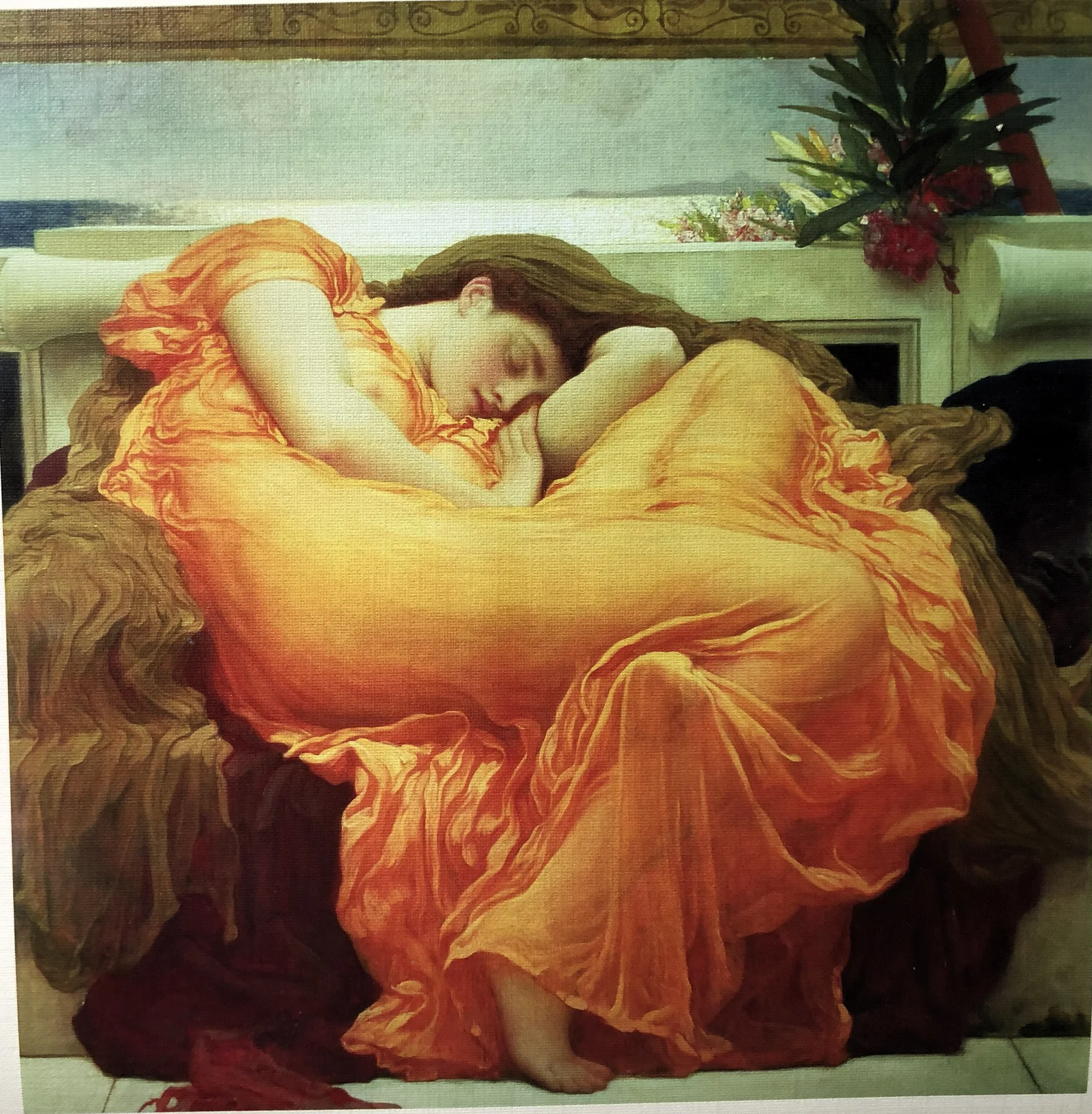
FLAMING JUNE
Lord Frederic Leighton
- Artist
- Lord Frederic Leighton (1830–1896)
- Date
- c. 1895
- Dimensions
- 120.6 x 120.6 cm
- Medium
- Oil on canvas
- Location
- Museo de Arte, Ponce, Puerto Rico
Perhaps Frederic Leighton’s finest work, Flaming June, a captivating, study-like portrayal of female beauty, immediately takes hold of the viewer. The lavish depiction of the woman sleeping in a veil-like, transparent dress is all the more remarkable when we consider that the picture was made in the Victorian age, notorious for its prudery. Leighton studied in Brussels, Frankfurt and Paris, then broadened his extensive professional knowledge in Rome and Florence before returning to his native England in 1855. In the 1860s and 1870s he created many dramatic narrative paintings depicting historical or biblical stories, such as Elijah in the Wilderness (1878). His pictures clearly illustrate his passion for classical ideals and his expert interpretation of the perfected harmony of ancient Greek art and culture. A further inspiration for the Victorian artist was the seemingly self-evident simplicity of the compositions of the Renaissance master Raphael.
A Classical Ideal
As a leading figure of the movement that played a part in the return of Classicism in England, Leighton turned to the ideal of beauty. To perfect his style he went back to ancient Greek sculpture and architecture, often drawing his subjects from mythology. In 1895, when Flaming June is thought to have been completed, Leighton was 65, suffering from heart disease and nearing the end of his life (he died the following year). Yet the painting is full of life and enchanting beauty. Leighton had first visited Greece nearly 30 years earlier, in 1867, and painted many pictures in a similar style, but it was probably with Flaming June that he managed to depict female beauty most expressively, in the figure of a sleeping Venus.
A Lost Masterpiece
Flaming June was made around 1895 and was first shown at the Royal Academy in London. The picture found no buyer, and the family kept it until the artist’s death the following year. After that the painting’s fate cannot be traced for a good while; it only resurfaced in the 1930s in a barber’s shop in London’s Mayfair district. It then disappeared again and was rediscovered in 1962 behind the panelling of a room in a London house about to be demolished. In the early 1960s Victorian works of art were not exactly in fashion; the painting’s heavy frame recalling Greek columns was valued more than the work itself, which did not find a buyer at auction even at a low starting price. Flaming June was finally bought by Luis A. Ferré, later governor of Puerto Rico, for the Museo de Arte in the city of Ponce in Puerto Rico, where it can still be seen today.
A Victorian Venus
The model for Flaming June was Dorothy Dene, who often appears in Frederic Leighton’s pictures. Leighton depicts his model in a relaxed pose, almost dreamlike; the artist’s classical ideal takes shape. The picture shows an interesting balance of cold and warm. Leighton observed his model closely and painted her with cool elegance, yet the painting also radiates warmth: the title itself, Flaming June, alludes to this, and the fiery colours of the dress heighten the feeling.
Above the model’s head the light of the setting sun is reflected on the water of the sea. We cannot know for sure whether it is a real sea or just a painting in the background — the ornate band at the top of the composition looks like a picture frame. The rays of the sun glinting on the water, however, seem to surround the sleeping model’s head with a halo, perhaps another allusion to the mysterious figure of the painting, the sensual goddess.
Velvety and Lavish
With his impeccable technique and velvety-smooth brushstrokes Leighton created a wonderfully balanced composition of his model, a sleeping Victorian Venus. He masterfully transferred to his own canvas the flowing folds of the drapery seen on the Greek statues he loved so much, at the same time bringing into the picture a movement so hard to render in a cold block of stone. The virtuoso depiction of the creases of the flowing orange silk is perfection itself. The shades of orange vary as the dress clings to the model’s skin or folds back in pleats, taking on a fuller colour.
- Greek statue of Venus
- Leighton: Dorothy Dene