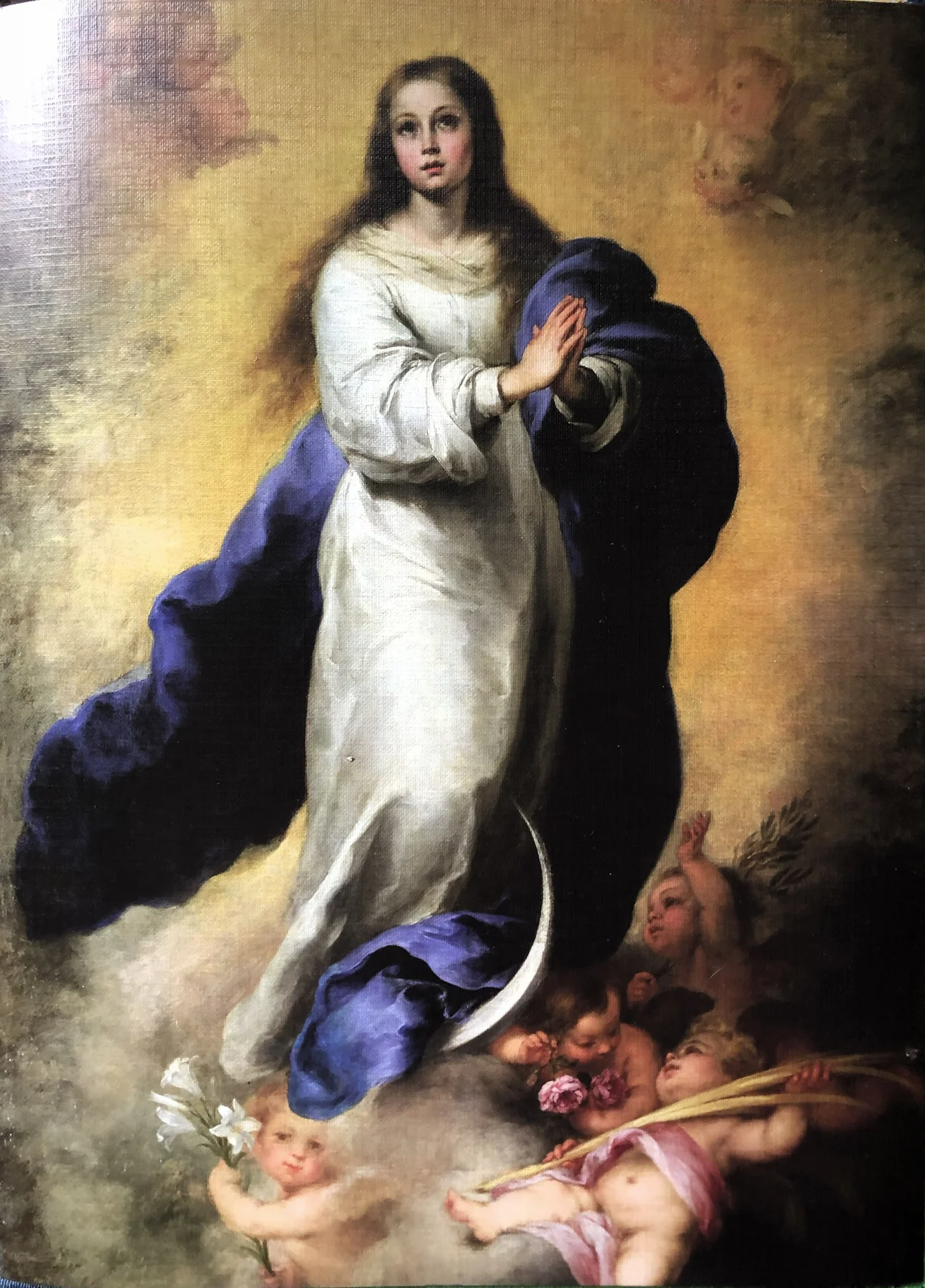
THE IMMACULATE CONCEPTION
Bartolomé Esteban Murillo
- Artist
- Bartolomé Esteban Murillo (1617–1682)
- Date
- Between 1660 and 1665
- Dimensions
- 206 x 144 cm
- Medium
- Oil on canvas
- Location
- Museo del Prado, Madrid, Spain
Bartolomé Esteban Murillo was one of the most outstanding figures of the golden age of 17th-century Spanish painting, alongside Velázquez and Zurbarán. Like many artists of his time, including El Greco and his compatriot Velázquez, he too painted the Immaculate Conception, the Virgin Mary. He returned to this subject again and again as he tried to create the perfect image — The Immaculate Conception shown here is one of his most popular and influential depictions of the Virgin Mary.
The Immaculate Virgin Mary
The Immaculate Conception is one of many religious pictures by the deeply Catholic Murillo; they include, for example, The Last Supper and the Virgin of the Rosary. This painting is only one version of his paintings on the theme of the Immaculate Conception. The term refers to the Roman Catholic dogma that the Virgin Mary was conceived immaculate, that is, without original sin. This is often — wrongly — taken to refer to the conception of Jesus, but it is the “immaculate” Virgin Mary who received this divine grace.
Unknown Origin
The date of The Immaculate Conception is not known. Many art historians suggest the mid-1660s as a possible date, while others date the work to the beginning of that decade. Opinions also differ about the painting’s more recent history, since until the mid-20th century the picture was wrongly catalogued as another version. It seems certain, however, that this depiction of the Immaculate Conception — distinguished from other pictures on the same subject as The Immaculate Conception of El Escorial — was placed in the Casa del Príncipe palace at El Escorial at the end of the 18th century. Today this popular religious picture, together with Murillo’s other paintings of the Virgin Mary, can be seen in the Prado Museum in Madrid.
A Sevillian Master
Murillo’s drawings, including his sketches and studies, clearly illustrate the Sevillian painter’s masterly, virtuoso technique. The artist made several preparatory drawings of different structures for The Immaculate Conception, from which he created the final work. In this heartfelt depiction of the Virgin Mary and angels Murillo uses a characteristic style known as “estilo vaporoso”, or “vaporous technique”. The artist applies the paint with the lightest brushstrokes, resulting in a soft blending of the clouds and figures in the background; this gives his painting an ethereal, otherworldly atmosphere. The long hair of the beautiful young Virgin Mary merges into the background, while the angels floating above her seem to dissolve into the light, cotton-wool clouds.
Religious Images
Murillo followed the guidelines on the images and symbolism of religious paintings in Arte de la pintura (The Art of Painting), published in 1649 by the influential Sevillian artist of the time, Francisco Pacheco. Accordingly, the Virgin Mary’s white dress symbolises purity, and her blue cloak heaven. The oval heavenly light surrounding her also conforms to the style of the time. The Immaculate Virgin stands, or rather floats, on a platform of clouds and angels. Some angels touch her with playful gestures as if she were their mother. The image of the bright white crescent moon beneath her feet was also used by other artists in their works, such as Velázquez, Pacheco’s former pupil, and the master, Pacheco, himself.
A Vision of Devotion
Despite the painting’s visionary presentation, the Virgin Mary is a figure of flesh and blood. The artist depicts the innocent girl becoming a woman fully frontally, in the bloom of her youth and beauty. Murillo shows Mary with a gentle expression as she raises her dark eyes towards heaven. Her figure is younger, more serene and more charming than in Murillo’s other pictures on the same subject made in […]. The artist’s famous work, the Soult Immaculate Conception of 1678, probably shows the same model, but at least a decade later, with much more mature and feminine features.
Charming Angels
The centre of the composition is of course the radiant image of the Virgin Mary depicted in light blue, but the artist also endowed the angels with wonderful beauty. The angels at the top of the picture are less visible than those below, so as not to distract attention from the Virgin Mary. The angel holding lilies looks straight out of the canvas, while the three figures arranged in a diamond formation are seen playing in the lower right quarter of the painting. One angel looks upwards, and another raises its left hand, which, together with the Virgin Mary’s praying hands and dark eyes, also points upwards, towards heaven.
- Velázquez and The Immaculate Conception
- The Prado Museum
- Murillo: The Soult Immaculate Conception