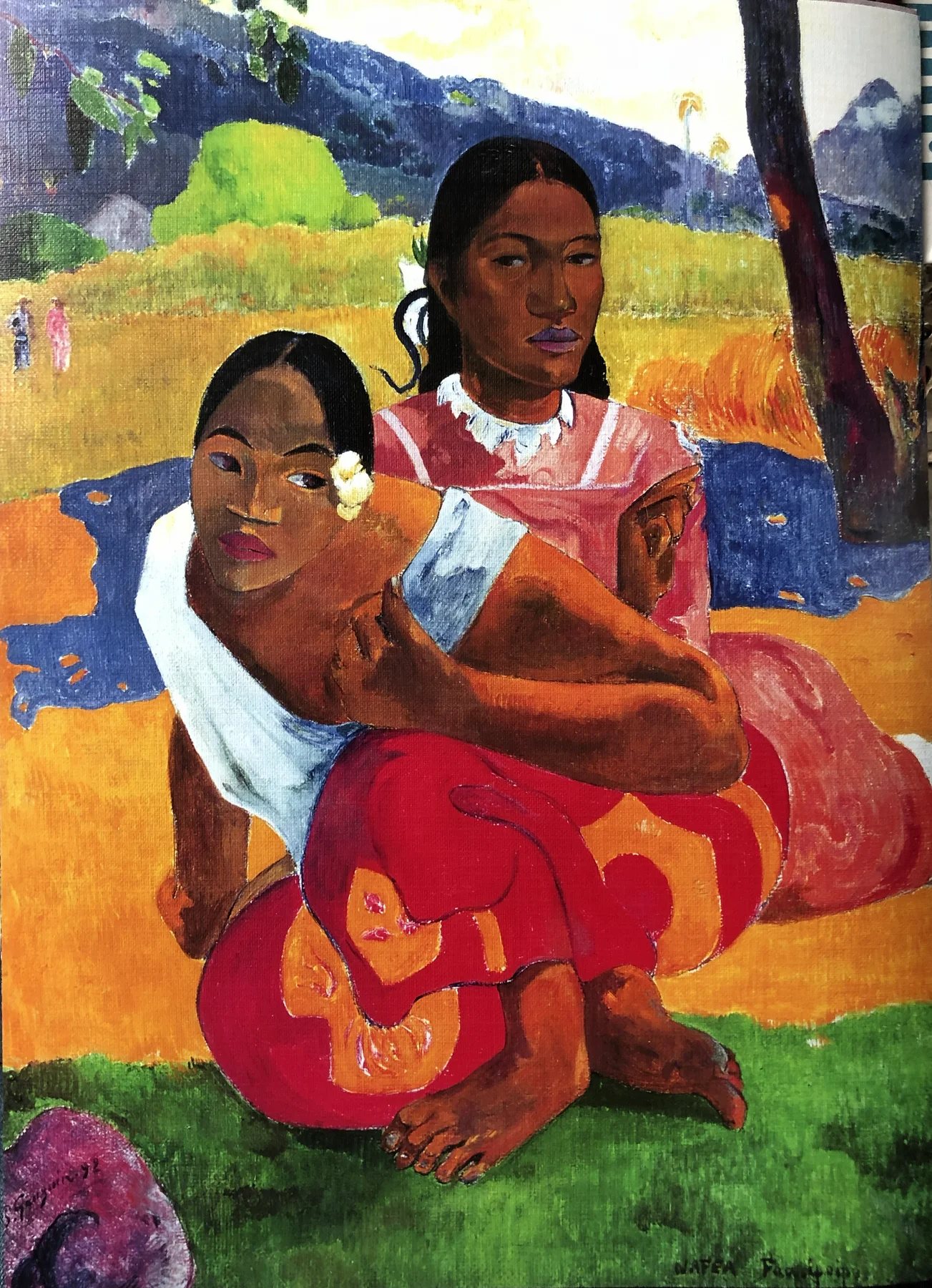
WHEN WILL YOU MARRY? (NAFEA FAA IPOIPO)
Paul Gauguin
- Artist
- Paul Gauguin (1848–1903)
- Date
- 1892
- Dimensions
- 101.5 x 77.5 cm
- Medium
- Oil on canvas
- Location
- Rudolf Staechelin Family Foundation, Basel, Switzerland
Two beautiful Tahitian women sit in a colourful, simply painted landscape; it is immediately recognisable that this exotic picture is a work by Gauguin. Once a well-to-do stockbroker, Paul Gauguin left his family and France in 1891 to fulfil his romantic dream of a simple life close to nature among the inhabitants of a South Sea island. Gauguin was dissatisfied with European life and civilisation and sought an undisturbed, paradisal place he could paint. Tahiti was of course not such a place; the island had in fact already begun to develop. The unhappy French painter later died there because of poor health. Gauguin, however, left behind a legacy full of important works, including When Will You Marry? His paintings became guiding lights of modern art.
A Simple Style
Completed in 1892, When Will You Marry? is one of the works Gauguin painted on the basis of his first Tahitian experiences. Dissatisfied with life and art, he began a new life in Tahiti and painted the island’s natives in a bold, fresh style. From the 1890s not only were the subjects of his paintings different, but the way he painted the inhabitants also seems strange and exotic. Gauguin wanted to express himself through his art and went so far as to move to Tahiti and try to understand the natives, indeed to see the world through their eyes. He simplified his style to convey his new feelings about life. The two female figures look sculptural, almost monumental, and this feeling and the bold, simplified forms are characteristic features that influenced many artists after Gauguin, since they too strove for a more primitive mode of artistic expression. When Will You Marry? has an intensity of colour that still seems very “modern” even to today’s viewer.
A Penniless Painter
When Will You Marry? was made in Tahiti in 1892. In August 1893 Gauguin returned to France for two years. By then he had become impoverished, but he had the opportunity to exhibit 46 of his works, including When Will You Marry? The picture was shown in 1893 at the gallery of the art dealer Paul Durand-Ruel with a valuation of 1,500 francs — one of the most expensive pieces in the exhibition. The painting can now be seen at the Rudolf Staechelin Family Foundation in Basel, Switzerland.
Vibrant Blocks of Colour
Gauguin painted different subjects and models in Tahiti, and his brushwork changed too. As the artist said, “I create symphonies, harmonies that represent nothing real in the true sense of the word.” In painting Gauguin clearly wanted to move away from the “real” and the “true to nature”. As one of the three influential Post-Impressionist painters of the late 19th century — alongside Van Gogh and Cézanne — Gauguin greatly influenced modern European art.
When Will You Marry? shows how Gauguin deliberately rejects the usual rules of traditional European painting. He paints simplified objects in strong, vibrant colours and seeks to separate forms from one another with dark outlines. As a result the whole composition looks flat, although in When Will You Marry? Gauguin treats the landscape in the foreground and background very differently. In the foreground and middle ground he places strong, bright complementary pairs of red and green and orange and blue side by side to reinforce the bold visual effect. The colours also make the landscape flat. The greenish-yellowish vertical brushstrokes of the grass, however, are clearly visible in the background, and he paints the two tiny figures walking in the distance in a slightly blurred, Impressionist style. The dark blue mountains in the distance also give depth to the otherwise flat feel of the painting.
Connected Figures
When Will You Marry? is one piece of Gauguin’s series depicting women. Although the two women sit close beside each other, paradoxically they seem distant and separate. The title suggests that the girl in the foreground is contemplating marriage. The flower in bloom tucked behind her ear alludes to this. The slightly older woman behind her wears more modest, more Western clothing, typically the kind worn by the Christian missionaries who had appeared on the island almost a century before Gauguin.
Gauguin placed the two figures in a triangle. The interesting arrangement of the figures, however, raises questions. The title does not seem to fit the picture. Despite their physical closeness, why do the two figures not seem connected? Perhaps the painting depicts that innocence, by its very nature, cannot be connected with knowledge or experience.
- Gauguin’s “hus pá” in Tahiti
- Woman with a Flower (1891) was also made in Gauguin’s Tahitian home