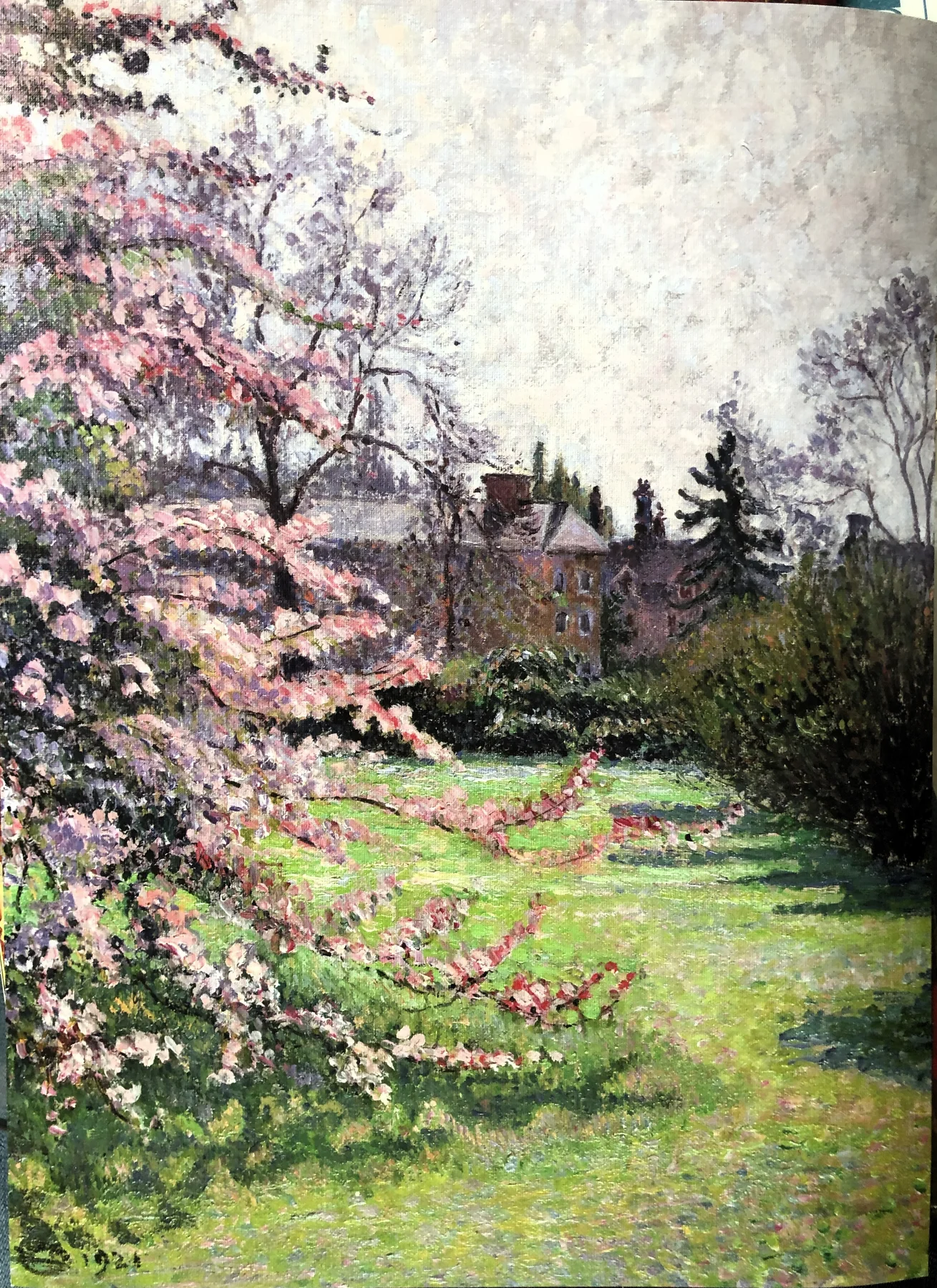
JAPANESE CRAB-APPLE BLOSSOM AT KEW
Lucien Pissarro
- Artist
- Lucien Pissarro (1863–1944)
- Date
- 1921
- Dimensions
- Unknown
- Medium
- Oil on canvas
- Location
- Private collection
The eldest and most talented son of the French Impressionist painter Camille Pissarro, Lucien Pissarro could boast a pedigree like few painters. In his receptive, tender years he was surrounded by great artists: Edgar Degas, Vincent van Gogh, Georges Seurat and, of course, his father. Pissarro’s subsequent success as an artistic torch-bearer of Impressionist and Post-Impressionist painting was therefore never in doubt. Japanese Crab-Apple Blossom at Kew, painted in 1921, proves that even in the later part of his career Pissarro remained faithful to his artistic roots.
English Connections
Lucien Pissarro was born in France to French parents, but he had close ties with England, where he settled in November 1890 and became a citizen in 1916. His parents had married in Surrey, where they had fled during the Franco-Prussian War of 1870–1871, while his uncle lived in Bayswater, London. Throughout his life Pissarro travelled back and forth across the Channel between his native land and his chosen home. His travels over the years can best be traced through the titles of his paintings, some given English and others French names. Pissarro always objected to being proclaimed an English or a French painter and, when asked, often called himself a “Channel painter”. Understandably, however, the style of his paintings bore very much the distinguishing marks of the French Impressionism practised by his father, its pure, fresh colours and its strong, sharply defined brushstrokes.
Harmonious Paintings
Pissarro was above all a landscape painter and, like many Impressionists, delighted in the vibrant patches of colour of picturesque natural settings, but he also painted many portraits, mostly of his wife, Esther Bensusan. Pissarro called his landscapes “little corners which give a harmonious overall effect”. An excellent example of his work is Japanese Crab-Apple Blossom at Kew. The patchy, luminous colours merge to create a vibrant image of idyllic Kew Gardens in blossoming splendour, where the colour of the pink flowers is repeated in the distant buildings and the sky, and the cool shadows reflect the green of the grass and foliage, in genuine Impressionist style. At the time he painted Japanese Crab-Apple Blossom at Kew, Pissarro was living with his wife and daughter in his manor house, The Brook, in nearby Chiswick. Before moving there in 1902 they had lived a stone’s throw away in Bedford Park, so he knew the Kew area extremely well. For Pissarro Kew was an Impressionist oasis right on his doorstep, on the edge of the city. He painted more than twenty pictures of its beautiful gardens.
A Well-Travelled Artist
In painting open-air pictures in and around London Pissarro was again following in his father’s footsteps. The elder Pissarro had been in England in the early 1870s and painted landscapes such as Lordship Lane, Upper Norwood (1871), which in technique and subject is very similar to Lucien Pissarro’s much later work Well Farm Bridge, Acton (1907). The younger Pissarro, however, travelled much more widely across England than his father had been able to, and from 1903 until his death in 1944 he made more than 450 oil paintings of the English countryside.
A Special Talent
Pissarro first travelled to England with his parents in 1870, and returned in 1890 on the advice of his father, who thought that his son’s growing talent for woodcuts and prints could provide him with a living. It was his paintings, however, that most attracted the attention of his English contemporaries, and the pictures also had a great influence on artists such as J. B. Manson, the future director of the Tate Gallery, or Walter Sickert, who called Pissarro “an original talent”. Pissarro took part in the last Impressionist exhibition in Paris in 1886, and as the son of “one of the fathers of Impressionism”, many English artists regarded him as an Impressionist.
A Key Figure
Pissarro tried to promote Impressionism not through official organisations — such as the Camden Town Group or the New English Art Club. In 1919 he founded the cross-Channel Monarro Group and worked with J. B. Manson in London and Theo van Rysselberghe in Paris to support artists inspired by Manet and Pissarro. Although overshadowed by his famous father, Lucien Pissarro nevertheless remained a key figure in art history, helping to make Impressionism more widely attractive and understood long after its beginnings in the picturesque surroundings of Paris.
Masterpiece Connection
Camille and Lucien had a close father-son relationship, but for a time they also became master and pupil, when they worked together at Eragny near Paris between 1884 and 1890 (Camille’s painting, Frost at Eragny, pictured). Both artists loved snowy landscapes, and the all-pervading reddish light in Lucien’s painting Stamford Brook Green, Snow (1927) recalls his father’s picture Lower Norwood under Snow (1870).
- Japanese gardens at Kew
- Bedford Park
- Walter Sickert