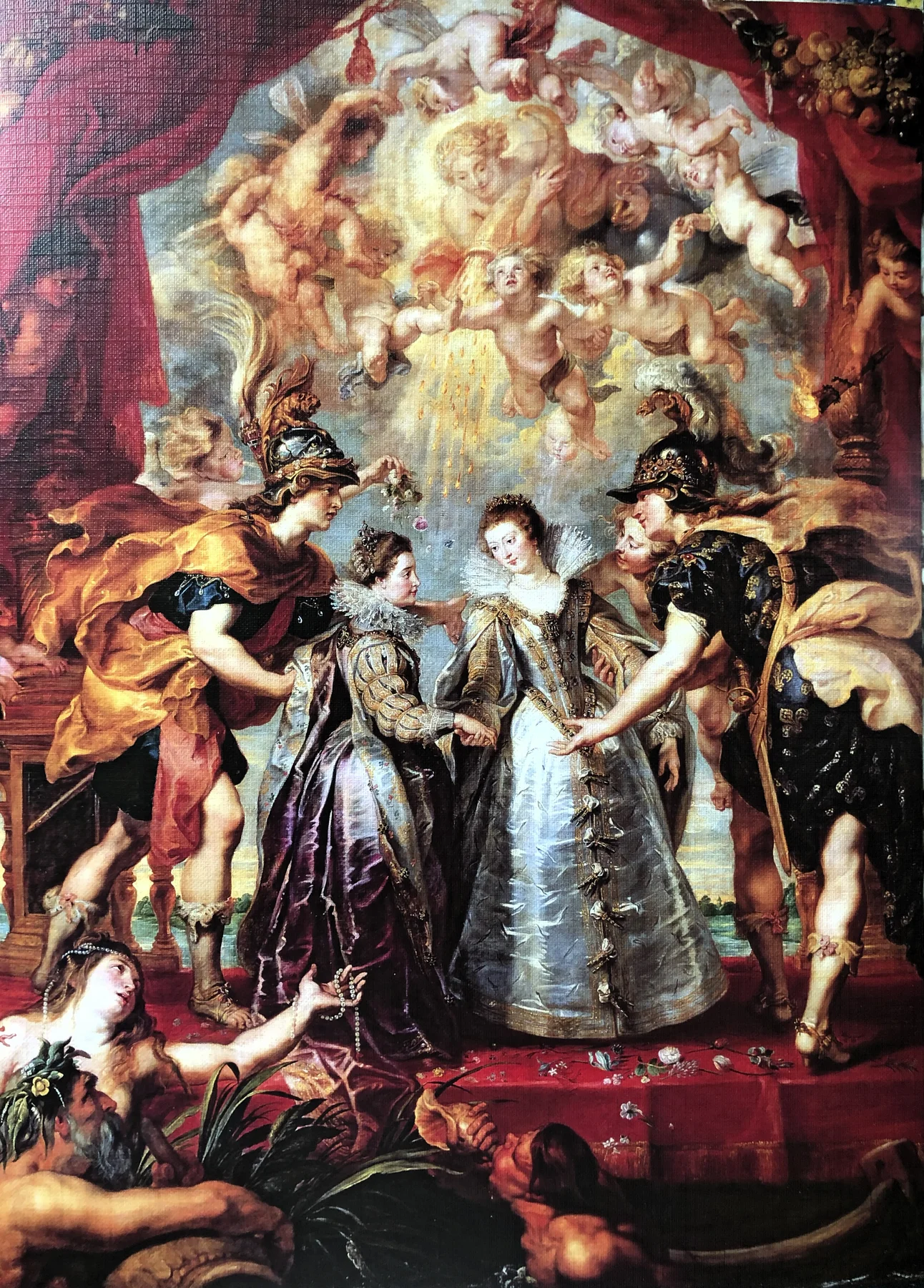
MEDICI CYCLE: THE EXCHANGE OF PRINCESSES OF FRANCE AND SPAIN
Peter Paul Rubens
- Artist
- Peter Paul Rubens (1577–1640)
- Date
- Between 1622 and 1625
- Dimensions
- 394 x 295 cm
- Medium
- Oil on canvas
- Location
- Louvre, Paris, France
The great Flemish painter Rubens was the most influential figure of Baroque painting in northern Europe. In his pictures he captured exceptionally dramatic scenes. He owed his fame to his religious and historical works, celebrated for their movement, colour and vitality.
Glorifying the Patron
Rubens, who had become known in France through his earlier excellent paintings — the triptychs The Elevation of the Cross and The Descent from the Cross — received a prestigious commission in 1621. The Queen Mother of France, widow of King Henry IV, Marie de’ Medici, summoned the artist to Paris and began negotiations with him about creating a huge series of paintings for the new royal residence, the Luxembourg Palace in Paris. Under the commission Rubens was to make 24 paintings: 3 portraits and 21 other compositions about the life of Marie de’ Medici. His patron wanted the excellent Flemish painter to glorify her life in his works, which was no easy task, since the Queen Mother’s past was rather questionable. On one occasion she had even been exiled to Blois, accused of conspiring against her son, Louis XIII, but after they were reconciled she returned to Paris in 1620.
A Contract for a Series
The negotiations progressed quickly, and by January 1622 the subjects of 15 compositions had already been agreed. This was not simple either, however, since the vain and wilful Queen Mother was not exactly a beauty. To fulfil this special commission Rubens needed great tact and ingenuity. According to the contract of 22 February 1622, Rubens’ task was to present “the Queen’s exemplary life and heroic deeds”. Within three months Rubens had designed the whole series, including the 14th composition, the future The Exchange of Princesses of France and Spain. The artist worked in his Antwerp studio and delivered the first nine finished paintings to the queen in May of the following year. Marie de’ Medici and Cardinal Richelieu, the chief minister, were delighted with the paintings and with the painter himself.
History and Allegory
Like the other paintings of the Medici cycle, The Exchange of Princesses of France and Spain is an allegorical presentation of a historical event. In creating the series the greatest difficulty for Rubens was designing compositions of contemporary events. Besides pleasing his patron, Marie de’ Medici, and her chief advisers, he could not risk offending the Queen Mother’s son, Louis XIII, who was on hostile terms with his mother.
The Missing Heroine
The most important thing we can say about the painting is that the heroine, Marie de’ Medici, is missing from it. Nevertheless her spirit dominates the work, since it was she who brought about the agreement shown in the picture. Marie de’ Medici is credited with arranging the double political marriage of convenience between her daughter, Elisabeth of Bourbon, and Philip IV, the future King of Spain, and between Anne of Austria, of the Spanish Habsburgs, and the Queen Mother’s son, Louis XIII. Thus Marie de’ Medici became mother and mother-in-law of the two most powerful rulers of Europe.
At the Centre
The central place in the immediate focus of the picture is occupied by four persons: the two princesses and beside them the figures personifying the two countries, France and Spain. The 14-year-old Spanish infanta Anne, standing on the right, is about to be carried off by a muscular yet graceful figure whom we can identify as France from the Bourbon lilies on her dark dress, while almost as its mirror image the figure symbolising Spain, with a lion on her helmet, stands protectively behind the French princess Elisabeth, depicted in profile.
The three water figures from mythology in the lower left quarter of the picture allude to the setting of the double wedding, which took place at a river near the French–Spanish border. In the water, below the floating stage with the red carpet, a bearded river god leans on his urn. The water nymph holds coral in her right hand and with her left holds up a string of pearls, while the triton blows his conch to celebrate the momentous double political alliance.
The Greatest Master
Around 1610 Rubens proved that besides religious pictures — such as The Adoration of the Magi made in 1609 — he was also a master of history painting. He was aware of his special ability to arrange his figures in large compositions: “I confess that my natural gifts make me better suited to depicting large-scale works.”
Apart from the static posture of Princess Elisabeth of France, The Exchange of Princesses of France and Spain is a work full of energy. Rubens created and balanced this scene with a rich colour scheme. He took special pleasure in depicting the fine details of the splendid dresses and in rendering the dazzling golden raindrops with which the goddess of happiness showers the bride princesses.
Masterpieces on the Move
All the works of the Medici cycle remained in their original location, the spacious gallery of the Luxembourg Palace in Paris, from 1625 until the mid-20th century. In 1953 they were moved to a former special room of the Louvre, where the huge paintings were exhibited in chronological order, clockwise, according to the original arrangement. The first half of the series presents Marie de’ Medici’s childhood and coronation, while the second takes the viewer into more difficult times.
- The Elevation of the Cross
- Rubens: The Adoration of the Magi