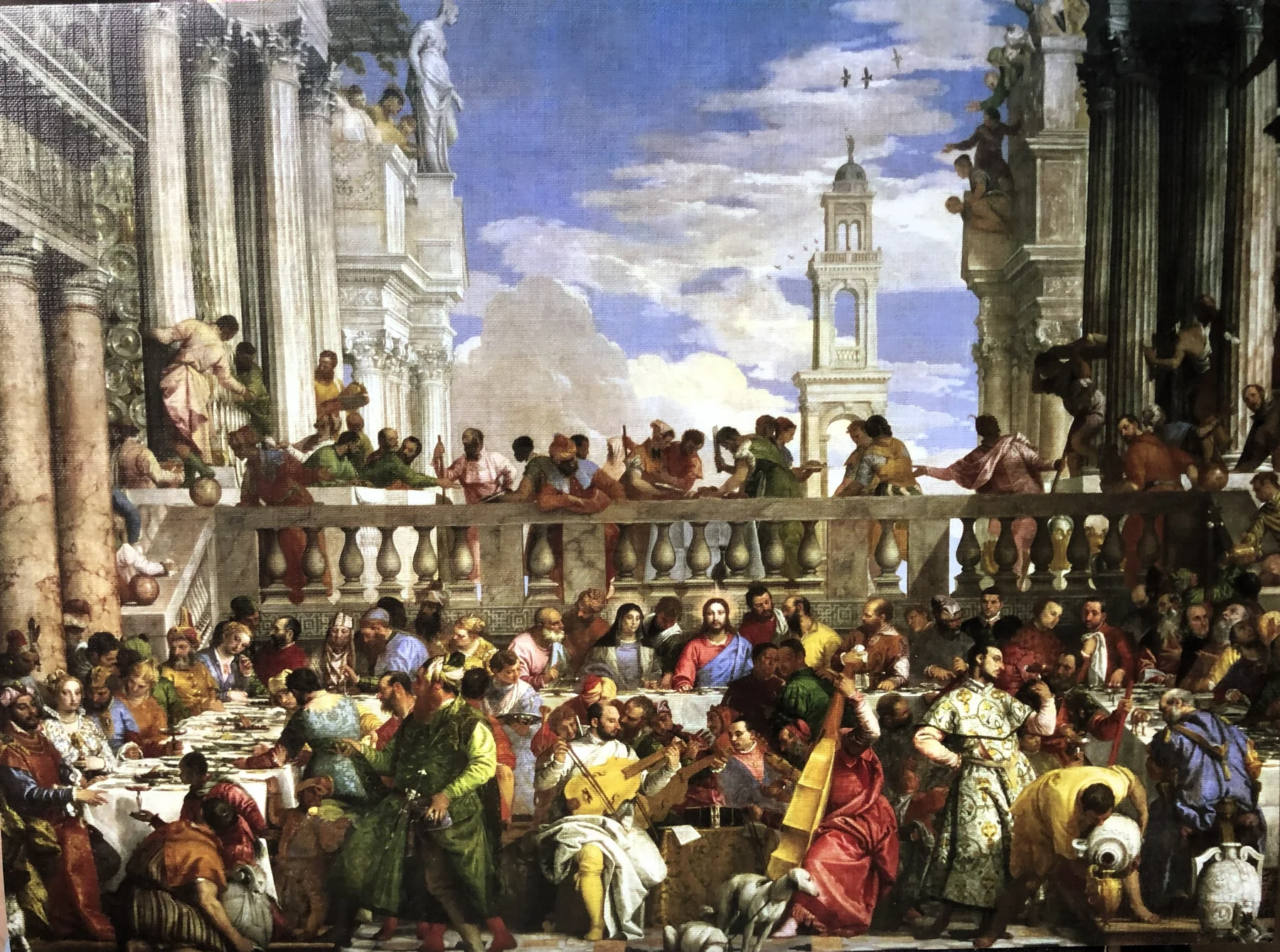
THE WEDDING FEAST AT CANA
Paolo Caliari (Veronese)
- Artist
- Paolo Caliari (Veronese) (1528–1588)
- Date
- 1562–1563
- Dimensions
- 677 x 994 cm
- Medium
- Oil on canvas
- Location
- Louvre, Paris, France
In The Wedding Feast at Cana Veronese turned the simple scene of Christ’s first miracle — the turning of water into wine — into a visual spectacle. The artist moved the wedding from Cana in Galilee to the most beautiful and luxurious Venetian setting, thereby transposing one of the most important biblical stories into his own time. An elegant and splendid fantasy world appears with only two figures not dressed in the fashion of the time: the Virgin Mary and Jesus Christ sit modestly at the centre of the picture, drawing the viewer into the picture too. Christ is the only one of the 130 figures who looks at the viewer. This work is a magnificent example of the talent of Veronese, who is still regarded as one of the greatest painters, among other things for his use of colour and the huge size of his works. The colours are brilliant; the artist painted the textures of the various materials with incredible craftsmanship. For a work of art of such size, the finish of the details is astonishing; the glittering jewels and the silver-gilt tableware, the food on the plates and the architectural details all confirm the artist’s talent.
A Sacred Commission
The Wedding Feast at Cana was commissioned by the Benedictine monks of the monastery of San Giorgio Maggiore in Venice to decorate their newly built refectory. The splendour, colour and richness seen in the painting contrast sharply with the monks’ way of life, but they expected the most perfect work possible. Veronese had to obtain the best oil paints; the colours and paints had to convey the specialness of the occasion. The dimensions of the painting are astonishing: it had to fill the entire back wall of the refectory, and the huge blue sky expanded the room, some 25 metres long. It must have been a splendid sight when they entered the hall. Veronese began work on the painting in 1562 and is said to have finished it in 15 months with the help of his brother, Benedetto Caliari.
This commission proved a turning point for Veronese, since thanks to the enormous success of The Wedding Feast at Cana he won fame and soon received many commissions for similar works in other church institutions.
A Colourful History
After 235 peaceful years in the monastery, Veronese’s masterpiece lived through turbulent times. In 1797 Napoleon’s troops confiscated the large-scale work, cut it in two, rolled it up and shipped it to Paris. It arrived at the Louvre in 1798, where it was sewn back together.
Despite every attempt to recover it, it has remained the property of the Louvre ever since. It was taken away during the Franco-Prussian War of 1870–71, and again during the Second World War. At that time it is said to have been stored on a lorry and moved to various locations. Yet even in the Louvre, one of the largest museums in the world, it suffered damage. In 1992 it was damaged twice during restoration: once by water, and the second time it tore in five places when the heavy painting fell to the ground.
Symbols
Based on the Gospel of John, the painting captures the moment at the wedding at Cana when Christ turns water into wine. On the right of the foreground two witnesses of the miracle watch the figure in yellow, who is just pouring the transformed water. Although the story has been somewhat altered — the people eating with Christ in the picture are clearly not poor — the God-fearing Veronese placed many allegorical elements in the painting to remind the viewer of the biblical story. One of the most important of these is the sacrifice of the lamb behind the figure of Christ; the blade can be seen above his head. The Lamb of God — Agnus Dei — is a symbol of Christ’s later sacrifice on the cross. Since the guests are apparently just eating the dessert, quinces — a symbol of marriage — the sacrifice of the lamb is only symbolic, as are the hourglass on the table and the dog eating a bone, further symbols of mortality and death. The Virgin Mary holds an invisible cup, symbolising the Holy Grail.
A Famous Neighbour
The Louvre is one of the largest museums and most famous art galleries, and its treasures include the Venus de Milo and this masterpiece. The Wedding Feast at Cana is the largest painting in the Louvre. Viewers are overwhelmed by the size of the work, emphasised by the fact that it can be seen in a relatively small space, almost the same size as its original home in the monastery. Opposite this large-scale, colourful painting showing 130 figures hangs a small and intimate masterpiece that had a great influence on Veronese and on countless artists since — Leonardo da Vinci’s Mona Lisa, perhaps the most famous painting in the world.
- San Giorgio Maggiore
- The Louvre, Paris, France