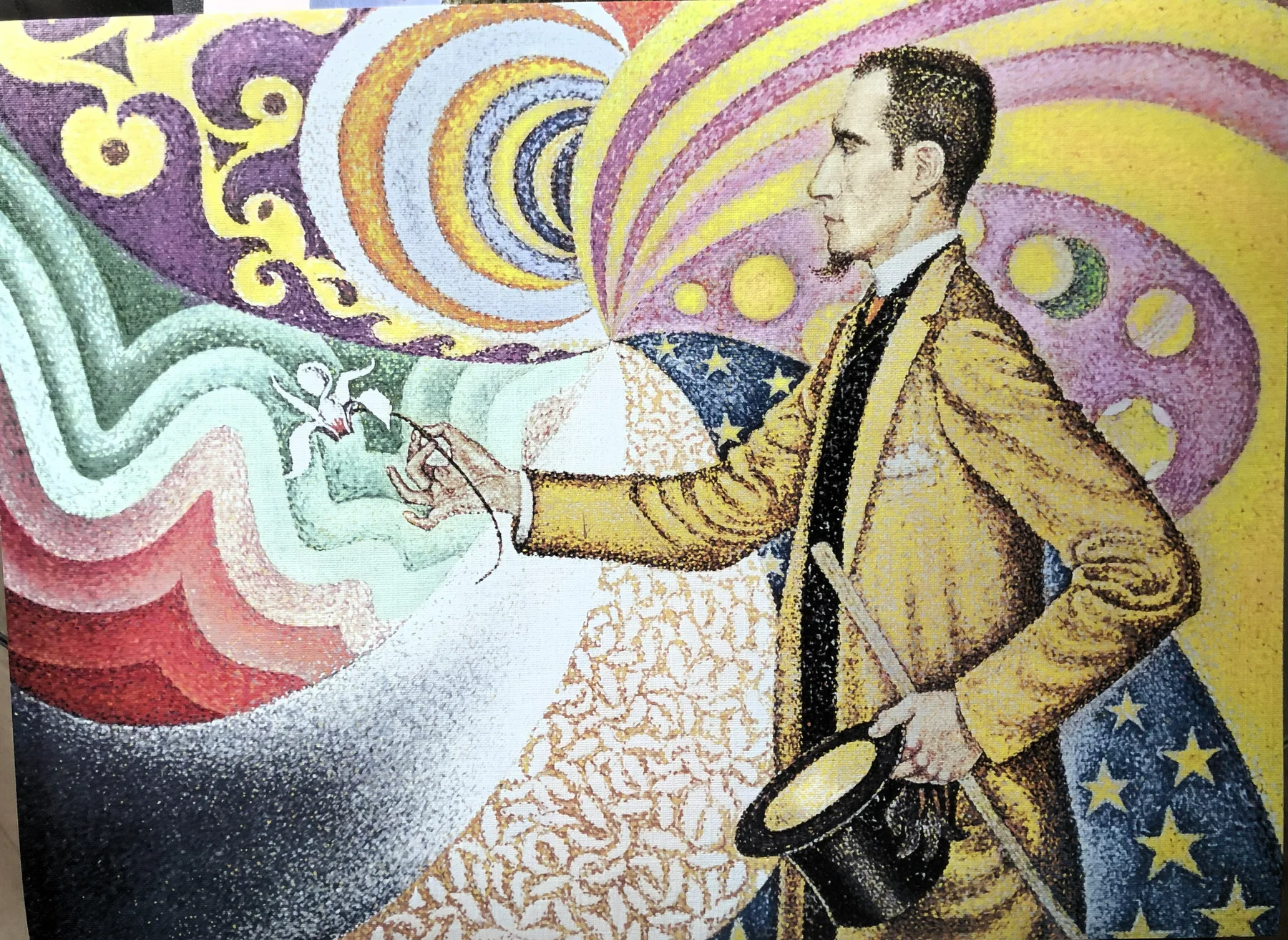
PORTRAIT OF FÉLIX FÉNÉON AGAINST THE ENAMEL OF A BACKGROUND RHYTHMIC WITH BEATS AND ANGLES, TONES AND TINTS
Paul Signac
- Artist
- Paul Signac (1863–1935)
- Date
- 1890
- Dimensions
- 73.5 x 92.5 cm
- Medium
- Oil on canvas
- Location
- Museum of Modern Art, New York City, USA
Paul Signac was one of the leading figures of the late-19th-century movement known as Divisionism. Its exponents created surfaces of vibrant colour from tiny patches, lines or dots. At the height of this movement’s popularity, in 1891, Signac made a portrait as no one had before: he created a modernist, fashionable, partly abstract and psychedelic pinwheel of radiating lines and patterns that would not have looked out of place on the Beatles’ Yellow Submarine, and on this colourful background he placed the figure of Paris’s leading journalist and critic. Was all this serious? No. It was mostly a private joke between two good friends.
Perceiving Dots
Paul Signac met Seurat in 1884, the year the latter exhibited his pioneering work Bathers at Asnières, made of unmixed, pure colours applied in small brushstrokes. This process, commonly known as pointillism or Divisionism (meaning the division of colour, dots of light of different colours), became the defining style of Neo-Impressionist works.
Signac liked Seurat’s art and soon adopted the technique, applying it in works such as The Milliners and Gasometers at Clichy (both made in 1866). In the summer of 1866, alongside Camille Pissarro and Henri Edmond Cross, the two artists were among the Divisionists at the historic second exhibition of the Société des Artistes Indépendants, the Society of Independent Artists.
Felix Coins a Name
Felix Feneon (or Fénéon) named this group of artists in 1886. He immediately took to Divisionism and championed it for years. Of the 1886 exhibition he wrote: “the Neo-Impressionist method demands an extremely refined way of seeing” — and the name stuck.
Feneon, whose close and lifelong friendship with Seurat began when they met around 1884, was one of the most interesting figures in the fin-de-siècle history of the Paris art world. By day he worked as a head clerk at the French War Ministry, and in his spare time he wrote articles for many art and literary magazines. He had an excellent eye for new writing and art: he later worked for the Bernheim-Jeune Gallery and became Henri Matisse’s most trusted dealer.
Happy and Sad Lines
Signac, Feneon and Seurat shared views on the theories developed in optics and colour science. They were fascinated by the astonishingly broad range of interests of the young librarian Charles Henry, which centred on aesthetics and sensory perception. Signac even collaborated with Henry, devoting countless unpaid hours to illustrating his theories with drawings.
One of these was the depiction of moods. Upward lines and warm tones, Henry argued, are “happy”, while downward strokes and cool tones are “sad”. All this is a rather unusual notion, and Signac probably felt an irresistible temptation to gently mock Henry and make this portrait of Feneon.
A Life-Size Souvenir
“I am thinking of painting a life-size souvenir of Felix Feneon this winter. What do you think?” Signac wrote to Feneon in 1890, who replied: “I should very much like to become your accomplice.” In letters exchanged during the summer they then worked out the idea, but they had very different ideas. Seurat spoke of “a very composed painting” and “an angular and rhythmic setting”. “A handsome Felix entering with a hat or a flower in his hand.” Feneon insisted only on “a likeness depicted fully frontally”, although even in this he was to be disappointed.
Switching to Japanese
Feneon appears in the portrait exactly as Signac imagined: in profile, with his hat and stick, holding a cyclamen. But Signac committed his most daring and unusual act in painting the background.
The pinwheel pattern was made after a Japanese woodblock print of around 1866–1880, probably based on a kimono owned by Signac. Japanese prints were enormously fashionable at the time, so the artist was taking a stand for modernity. What is more, the colours and patterns allude to Charles Henry’s theories, though only slightly, since Signac was fully aware of the limits of their artistic realisation. The painting’s jokingly elaborate title is said to parody Henry’s pseudo-scientific vocabulary.
The pinwheel and the portrait complement each other formally — one element is a splendid, linear, abstract creation forming a spiral, the other figurative — so the painting is strongly decorative; it creates a balanced effect pointing towards 20th-century modernism.
Unfortunately Feneon was extremely dissatisfied with the work; later in life he described it as “Signac’s least successful work”. Yet from the time Signac showed him the picture, he faithfully kept it on his wall until the artist’s death.
- Georges Seurat
- Felix Feneon
- The Trial of the Thirty