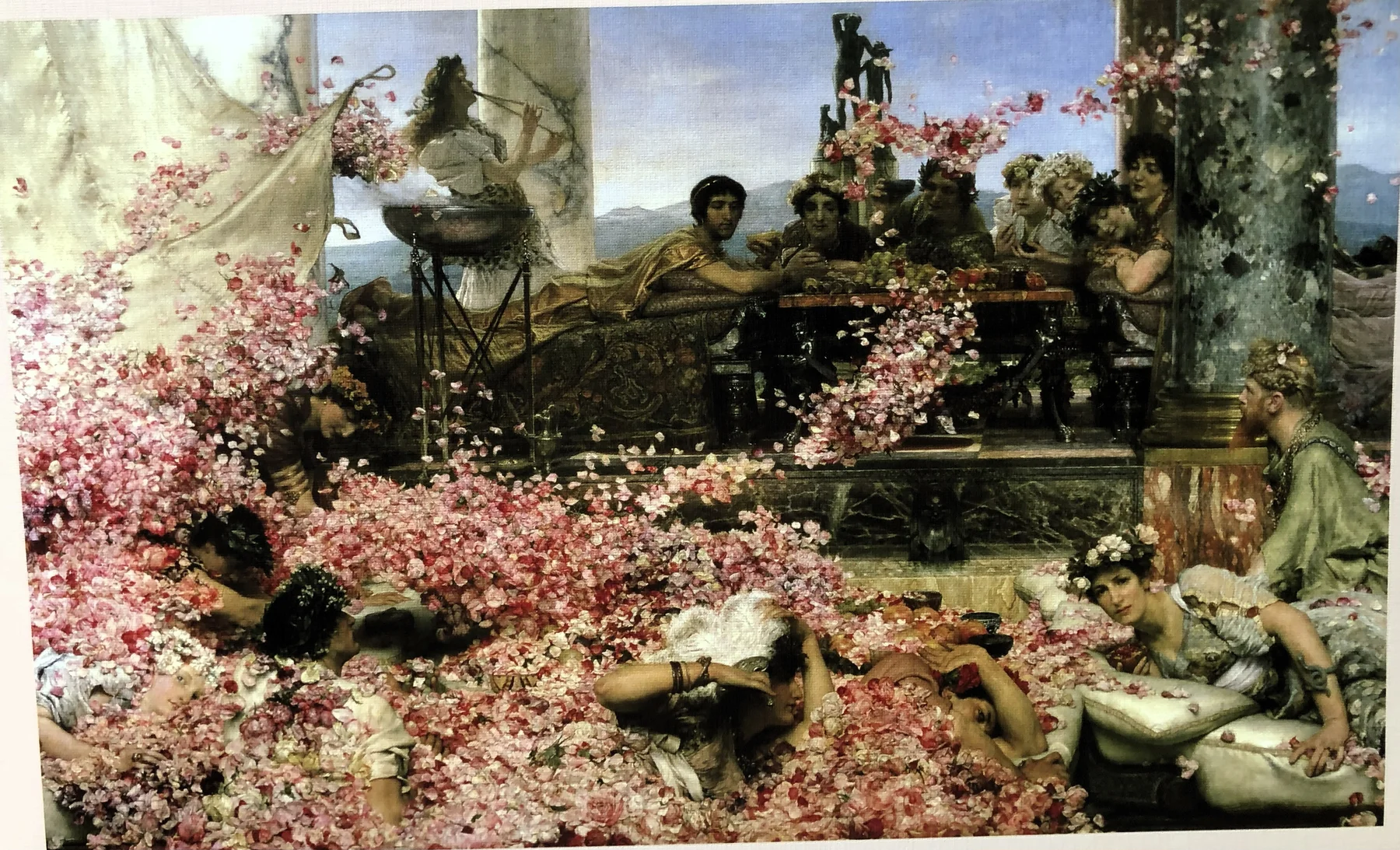
THE ROSES OF HELIOGABALUS
Lawrence Alma-Tadema
- Artist
- Lawrence Alma-Tadema (1836–1912)
- Date
- 1888
- Dimensions
- 132.1 x 213.7 cm
- Medium
- Oil on canvas
- Location
- Private collection
Born in the Netherlands and a British citizen from 1873, Lawrence Alma-Tadema was one of the most successful and popular painters of Victorian England. His expertise in ancient history is reflected in many meticulously crafted paintings depicting everyday scenes set in classical surroundings. In The Roses of Heliogabalus flower petals float down among revelling Romans, but a dark story lies behind the picture.
The Mad Young Emperor
Heliogabalus, also known as Elagabalus or Marcus Aurelius Antonius, was Roman emperor from 218 to 222. He married five times; accounts describe his capricious and decadent behaviour and his unbridled orgies, at which he occasionally mixed ground glass or animal dung into his guests’ food. The Roses of Heliogabalus records another such “joke” of his, when he is said to have suffocated some of his dinner guests under tons of flower petals. His own life came to an early end: he was murdered by members of his bodyguard at around the age of 19.
Victorian Taste
The Dutchman Alma-Tadema settled in London in 1870, having previously seen the famous Elgin Marbles at the 1862 World’s Fair. The Greek sculptures of the Athenian Parthenon caused an enormous stir in the 19th century, and many art lovers thought the heroic style of the works represented the pinnacle of artistic achievement. Alma-Tadema was deeply impressed by ancient civilisations, including the Greek and Egyptian, but Roman culture in particular captivated him. Unlike his contemporaries, who painted Greek legends and famous historical events, Alma-Tadema preferred to depict everyday scenes and the inner world of ancient Roman life. He wanted to show that “…the ancient Romans were people of flesh and blood just like us.”
In 1887 Alma-Tadema was commissioned by a wealthy building contractor named John Aird, a Conservative Member of Parliament, to paint The Roses of Heliogabalus. The commission gave Alma-Tadema the opportunity to create an ambitious work. The artist adored flowers, but in this picture he attempted the difficult task of depicting the fall of hundreds of rose petals.
Falling Out of Favour
Alma-Tadema was one of the best-paid artists of his time and received a handsome fee for The Roses of Heliogabalus. Aird commissioned the painting for £4,000, and Alma-Tadema finished it in 1888. After Alma-Tadema’s death the picture fell into oblivion. The Roses of Heliogabalus was offered at auction in 1960 but found no buyer even at its starting price of a modest £105. The painting was later acquired by Allen Funt, creator of the popular programme Candid Camera and a collector of Alma-Tadema’s paintings, then considered out of fashion. When Sotheby’s put the picture up for auction in London in 1973, its value soared to £28,000.
Ornate Marbles
The Roses of Heliogabalus clearly illustrates Alma-Tadema’s perfect technique and sensitivity to tiny details. His excellent abilities are best shown in painting the tangled flood of rose petals. Alma-Tadema is above all a master of the vivid depiction of materials of different textures, from feather-light rose petals and soft fabrics such as silk to hard, cold metals. He is also rightly praised for his depiction of marble and granite surfaces. In The Roses of Heliogabalus many different kinds and colours of marble come to life. Sunlight glints warmly on the green marble column on the right of the picture, yet the viewer can almost feel the coldness of the wonderful stone.
The bearded man below the column looks much more like a Victorian gentleman than a Roman, but the artist renders his features and clothing wonderfully, from his pink earring to the heavy gold chain hanging around his neck. A few rose petals rest on his carefully braided long hair. This detailed depiction gives prominence to the figure, who casts his gaze at the emperor lounging lazily in his sumptuous golden robe, as if calling him to account for the reason and purpose of the extraordinary rain of roses.
Murder by Rose Petal
The Roses of Heliogabalus is a very unusual composition with a kind of dreamlike quality. Although most of the human figures are almost sculptural, Alma-Tadema brings movement and momentum into the picture as a flood of rose petals pours down on the unsuspecting guests at the bottom of the picture. The painting depicts the moment when the petals begin to be scattered from the awning hanging in the upper left corner. The direction in which the flowers float — from the upper right corner to the lower left corner — shows, however, that the awning was released from the upper right corner of the painting.
Alma-Tadema is sometimes accused of his figures lacking life and movement; in this painting the careless poses radiate a general mood of indifference. The woman lying in the foreground strangely registers with insensitivity and indifference that guests are suffocating beside her. Although what is happening should provoke fear or outrage among the emperor’s subjects, the emphasis is on the emperor reclining in his golden robe, who looks on impassively at the scene. The bearded man’s serious, penetrating gaze directs our attention towards the emperor, the central figure of the picture. We can observe eight privileged persons around the upper table, while at least six guests are being covered by the flowers. The strange, indifferent or even doubtful expressions of the others show that they may not be aware of the drama of the situation.
- An etching depicting Heliogabalus
- Alma-Tadema: Study for The Roses of Heliogabalus, c. 1888