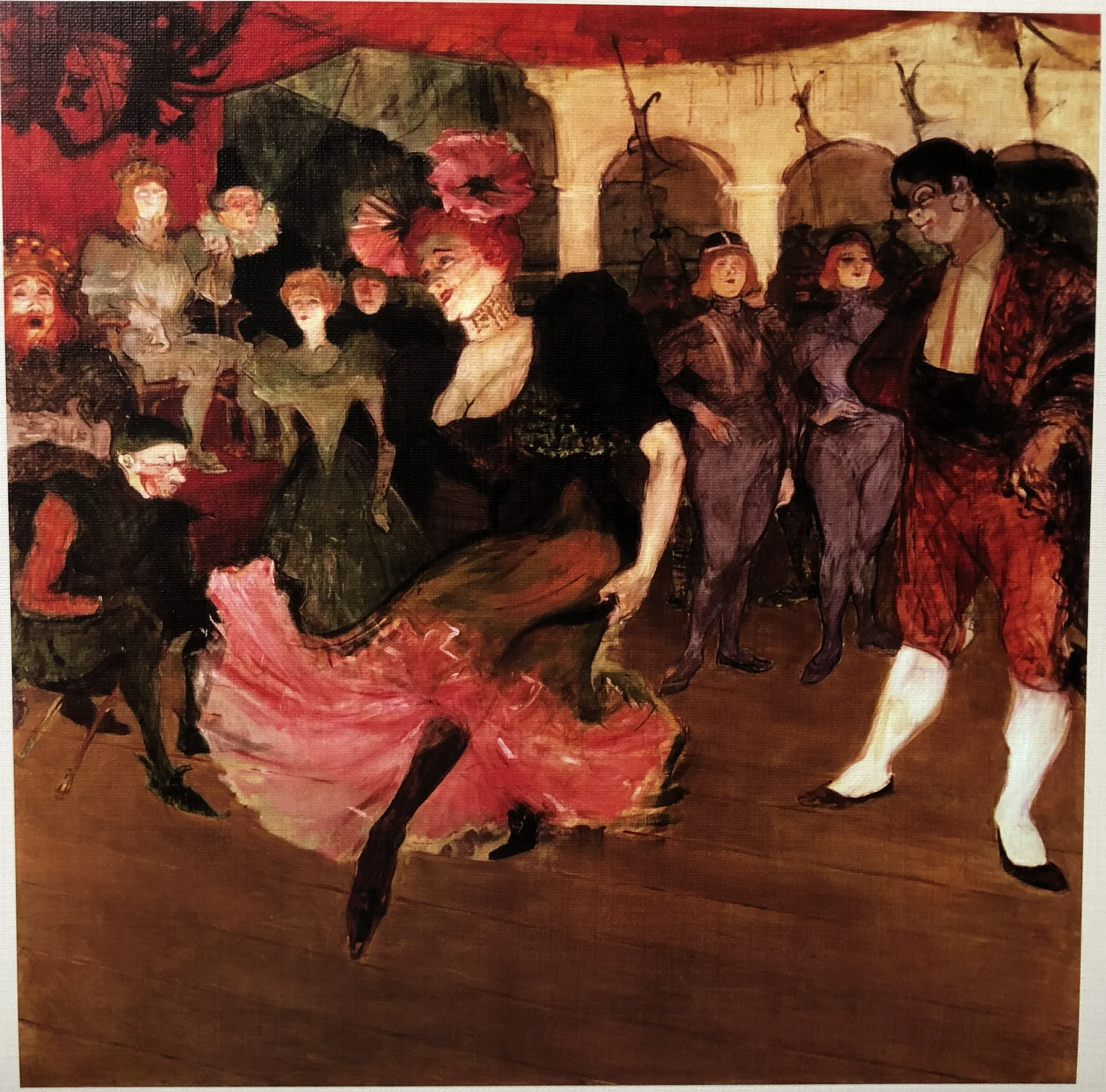
MARCELLE LENDER DANCING THE BOLERO IN “CHILPÉRIC”
Henri de Toulouse-Lautrec
- Artist
- Henri de Toulouse-Lautrec (1864–1901)
- Date
- Between 1895 and 1896
- Dimensions
- 145 x 149 cm
- Medium
- Oil on canvas
- Location
- National Gallery of Art, Washington D.C., USA
In the early 1880s the young Henri de Toulouse-Lautrec left his privileged but unhappy life in the south of France to move, for the sake of his artistic career, as far as possible from his aristocratic roots — to Montmartre, the squalid centre of Parisian life. Lautrec soon became the unofficial biographer of this neon-lit world and for almost two decades documented the lives of the characters whose performances brightened the cafés, restaurants and dance halls night after night. Thanks to his countless paintings, prints and posters he won great fame, not only for himself but also for the colourful company of performers on stage.
The Return of Chilpéric
Lautrec painted Marcelle Lender Dancing the Bolero in “Chilpéric” between 1895 and 1896, at a time when, under the influence of his friend the playwright and critic Romain Coolus, he was becoming increasingly interested in the theatre. Chilpéric was an opéra bouffe, an operetta, created by the singer-composer Hervé, based on the story of the Merovingian king Chilpéric, who ruled much of Europe at the end of the 6th century. The piece was first performed in Paris at the Théâtre des Folies-Dramatiques in 1868 but was soon forgotten. In February 1895, however, with the revival of the operetta genre, the piece was staged again. With beautiful costumes, a star cast and the splendid new home of the Théâtre des Variétés, the piece caused a sensation and ran for three months, achieving more than 100 stunning performances.
A Stage Diva
Lautrec was perhaps the show’s greatest fan. Every evening, in the company of Coolus or his friend Maurice Joyant, he took his usual place in front by the orchestra and obsessively drew the spectacle before him. Lautrec’s interest, however, was held not so much by the piece as by the dancer: the seductive diva. Marcelle Lender played Galswinthe, Chilpéric’s wife, whom her husband treated unworthily. In fact, when Coolus objected to Lautrec dragging him to yet another performance, the painter replied: “I come solely to see Marcelle Lender again… One rarely sees anything so magnificent.” During his Montmartre years Lautrec was rumoured to have shown serious interest in many female performers. He was said to have had a fondness for Jane Avril, Yvette Guilbert and, above all, the dancer Louise Weber, better known as “La Goulue”. In the mid-1890s, however, for a time he turned his gaze exclusively to Lender, attracted by the lady’s stunning personality and the sexuality radiating from the stage.
A Unique Painting
Lautrec first noticed Lender when the actress took the stage in the operetta Madame Satan in 1893. Lautrec made three lithographs of her for the magazine L’Escarmouche, and their publication brought the lady even greater fame. In all the artist made 15 lithographs, many sketches and two paintings of the actress, one of which is Marcelle Lender Dancing the Bolero in “Chilpéric”. This picture is one of Lautrec’s largest paintings, nearly 150 cm wide, but it also differs considerably from the other pictures painted of Lender.
In his earlier series of five lithographs of the lady’s role in Chilpéric, Lautrec put Lender in the spotlight, depicting her whole performance close up, from her first song to her final bow. The Chilpéric painting, however, does not focus specifically on the actress but gives an overall view of the stage, emphasising the grandeur of the whole performance. On the left Chilpéric sits on his dais, and on the right stands the lecherous Don Nervosa, who, taking advantage of his position, admires Lender’s beautiful back. At the centre of the picture we see Lender; the colour of her billowing pink skirt is repeated in the feathered flower ornament in her hair. One of Lautrec’s finest gifts lay in his ability to capture the characteristic qualities of his subject with a few expressive brushstrokes. Here we see Lender at the height of her performing art, her body in motion, her face a mask alluding to the tawdry glitter of the stage.
A Contradictory Personality
In Lautrec’s many sketchbooks nearly 17 drawings depict Lender performing in Chilpéric, although most of them tend towards abstraction. There are, however, several detailed figure studies, one of which served as the basis for the Chilpéric painting. Lautrec continued the painting in his studio the following year, with Lender even sitting for him in person. The lady tried to stand up to the artist’s peculiar behaviour and referred to him as “that dreadful man”. She also had an unfavourable opinion of his painting, as she later remarked: “He really does love me. But he can keep the painting.” Lautrec was a demanding man. On many occasions when Lender sat for him he asked her to repeat a refrain from Chilpéric over and over again because, as Lautrec claimed, in this way “her skin glows almost imperceptibly in the light”.
Although Lender felt antipathy towards Lautrec and his painting, the artist valued the picture extremely highly. He never exhibited it and kept it until his death in 1901. The painting then passed to his art-dealer friend Maurice Joyant, until it was finally bought in 1950 by John Hay Whitney, publisher of the New York Herald. In 1990 Whitney’s widow gave it to the National Gallery of Art in Washington for the museum’s 50th anniversary.
- Édouard Vuillard (centre left), Romain Coolus (centre right) and Félix Vallotton (right)
- Louise Weber, “La Goulue”
- Marcelle Lender