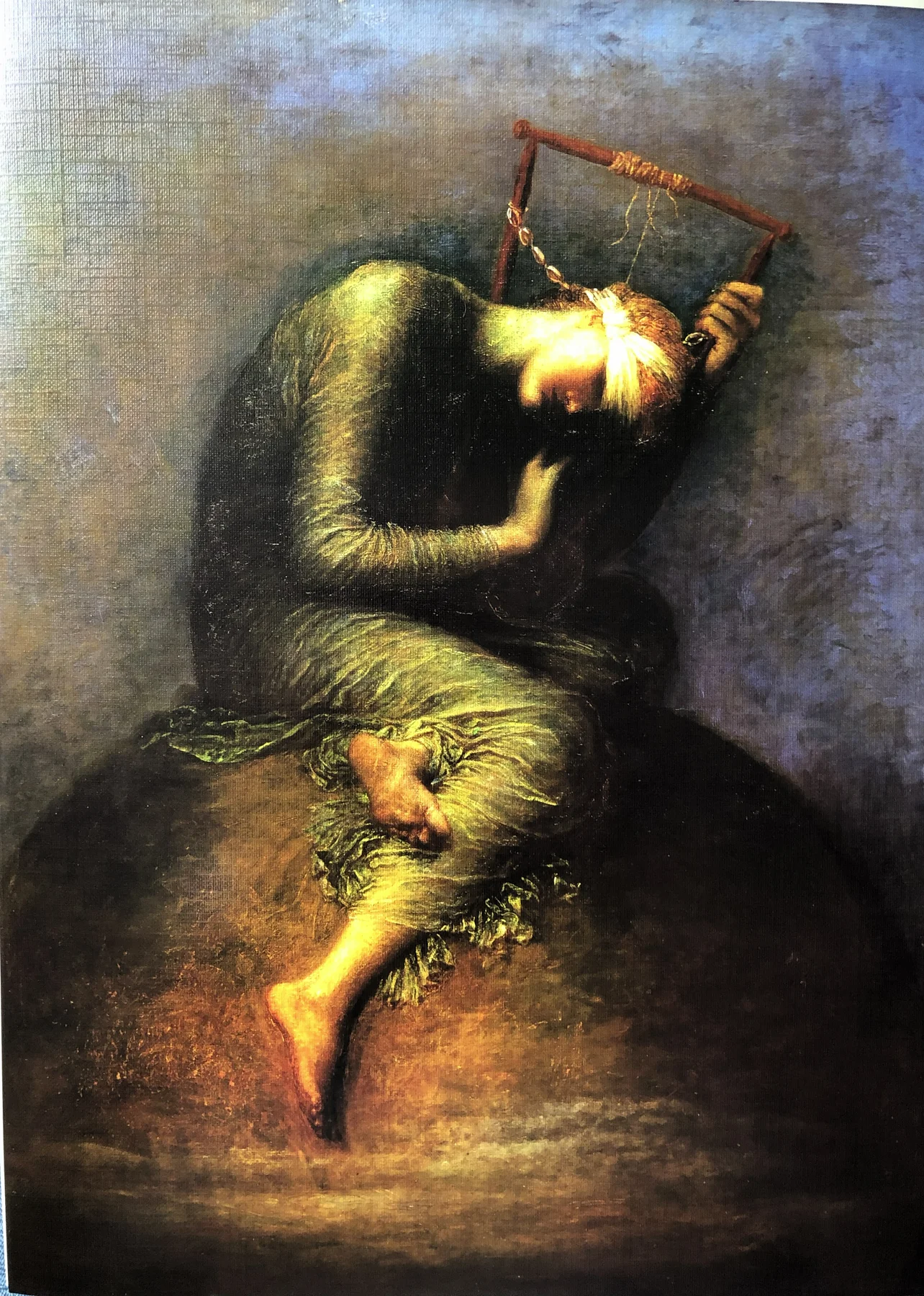
HOPE
George Frederick Watts
- Artist
- George Frederick Watts (1817–1904)
- Date
- 1886
- Dimensions
- 142.2 x 111.8 cm
- Medium
- Oil on canvas
- Location
- Tate Gallery, London
The English Victorian painter George Frederick Watts was considered one of the greatest artists of the 19th century. By the time one of his most famous pictures, Hope, was finished in 1886, his name was known worldwide. Like many other Victorian artists, Watts’ reputation declined considerably in the 20th century, and today he is praised more for his portraits than for his large-scale Symbolist or mythological works.
An Ambitious Plan
George Frederic Watts was an original, didactic artist who liked to deal with abstract ideas and themes and created figurative or character-portraying allegorical paintings. During his visit to Rome in 1847 he was deeply impressed by Michelangelo’s wonderful ceiling frescoes in the Sistine Chapel in the Vatican. Watts returned to England with ambitious ideas: under the title The House of Life he planned a lofty, decorative cycle of paintings for the public, in which he would put his own visions on canvas. Watts considered it important to find pictorial expression for his views on human nature and on various social problems — such as poverty and materialism.
Watts did not manage to carry out his ambitious plan, but from time to time he returned to the great themes originally intended for The House of Life, such as Time, Love, Life and Death. According to Watts, the idea for Hope, unlike many of his other works, came to him suddenly and self-evidently. This unusual and original personification of Hope, the solitary female figure, became one piece of his monumental Symbolist series.
Different Hopes
The first version of Hope was shown in 1886 at the Grosvenor Gallery in London, the centre of the Aesthetic art movement. The painting (now in a private collection) was a huge success; Watts made a second version, which he presented to the public at the 1889 Paris World’s Fair. The artist turned down an offer of several thousand dollars and gave the picture, together with 17 other Symbolist paintings, to the Tate Gallery in 1897, adding three more in 1900. The version of Hope shown here can now be seen in the Tate Gallery in the company of other Watts paintings, as one piece of the artist’s series on lofty subjects.
Soft Brushstrokes
Contrary to the painting’s title, Watts creates a melancholy atmosphere in his picture. The technique of many of his other Symbolist works is considered heavy and earthbound, but Watts had great imagination and a distinctive style. He tried various techniques that were considered unique and unusual in his time. Today we might call them modern, since Watts used anything “that came to hand” to apply paint: paper, rags, even his finger. Watts preferred this second version of Hope to the original, since its softer brushstrokes create a finer, more ethereal mood. The shades of bluish grey, brown and green produce a harmonious overall effect. The artist renders Hope’s thin, transparent dress, its intricate folds and yellow-tinged highlights with a refined technique.
Emotional Strings
Hope depicts a blindfolded young woman, clutching an instrument, sitting hunched on a round surface that at first glance looks like a perfectly polished piece of rock. The mysterious picture immediately catches the attention as soon as the viewer realises that it is a Symbolist work. The barefoot beauty is in fact sitting on a globe and playing her broken lyre. With her left hand she grips the instrument tightly, with her right she plucks the remaining string, bringing her ear close to the source of the music. The painting’s title seems at odds with the sight, since this is not the usual Christian depiction one would expect from its name. Watts was not religious in the traditional sense of the word, but he later also painted Faith (c. 1890–1906) and Charity (1898), thus presenting the three Christian virtues.
Watts defended his ambiguous painting with these words: “Hope need not necessarily mean expectation. It is rather a feeling, like music, which may arise from the sounding of a single string.” Although Hope seemed to be balancing on a razor’s edge, and malicious contemporary critics found the title “Despair” or “Sorrow” more appropriate, the Symbolist painting made a deep impression on the Victorian public. Many anecdotes attest to the positive, life-affirming power of this mysterious and enduring picture, which served as an inspiration to many people in the years that followed.
- Watts: Time, Death and Judgement
- The first version of Hope