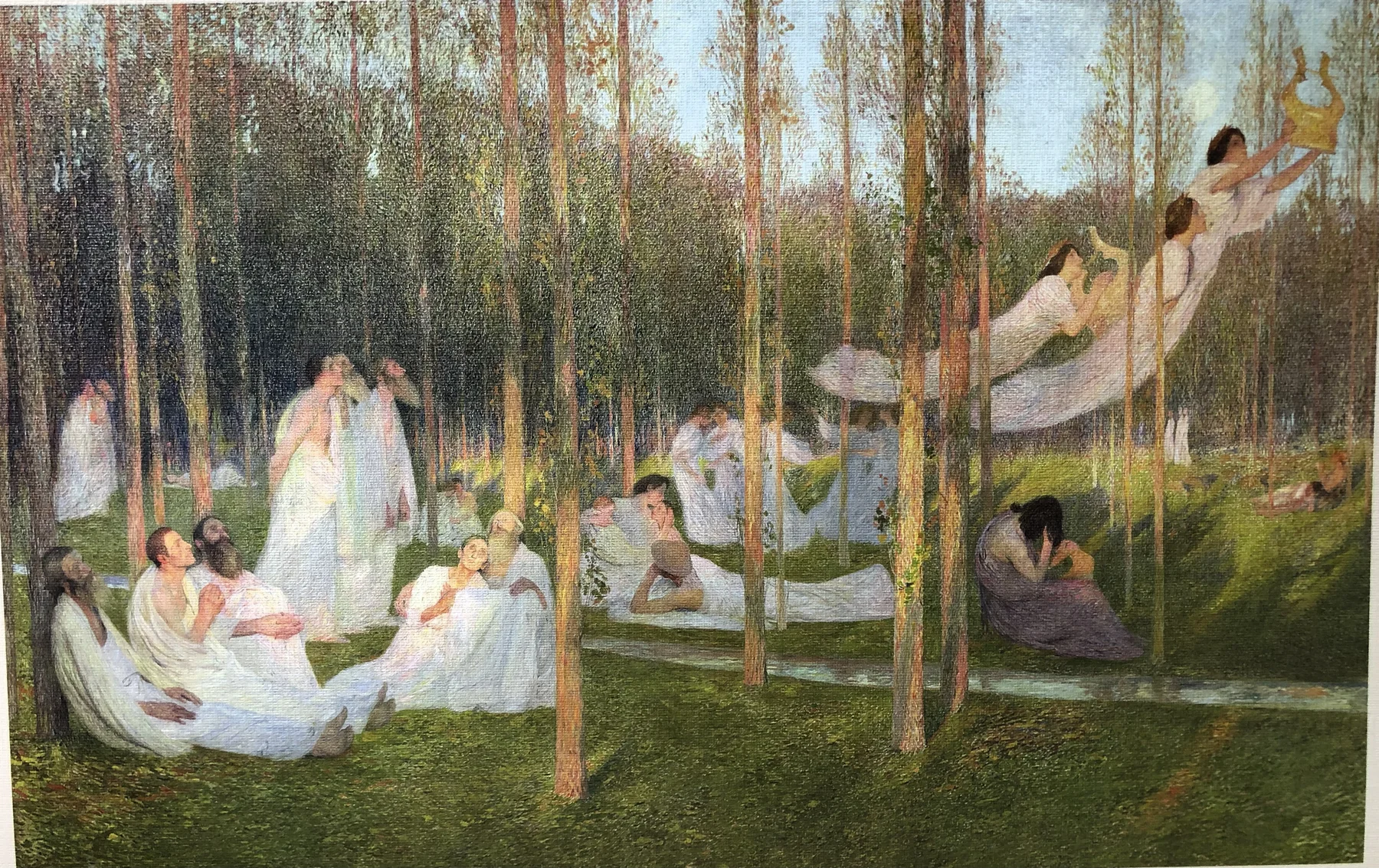
SERENITY (SÉRÉNITÉ)
Henri Martin
- Artist
- Henri Martin (1860–1943)
- Date
- 1889
- Dimensions
- 544 x 347 cm
- Medium
- Oil on canvas
- Location
- Musée d’Orsay, Paris, France
The huge painting, nearly 5.5 metres wide, Serenity depicts an idyllic scene from Virgil’s Aeneid, when angels lead souls towards true happiness: to the Elysian Fields, the final resting place of virtuous souls. The painting bears an extremely apt title: its languid colours and the dreamlike floating of its figures exude an air of silence and calm. This lofty Symbolist work radiates peace and spirituality. Serenity is not among Henri Martin’s most characteristic paintings, since his landscapes usually contain no human figures, but this is no ordinary earthly scene. Martin adored nature and in Paris longed for light. Among contemporary artists and critics he was famous for his use of colour and for his ability to evoke the slightest quivers of light with his brushstrokes. He worked with such fine and precise brushwork that it was closer to dot-like depiction than to long strokes. His colours were so natural that the dots blended harmoniously together.
First Showing
The painting was first shown at the Salon of the Society of French Artists in 1899. This period marked a turning point in Martin’s life, since the following year he left Paris for the south of France.
Emotional Canvases
Symbolism is a very broad term for the artistic style of the turn of the 20th century. The movement rejected literal interpretation, replacing it with the memories and suggestions of soaring imagination, thereby raising emotion above reason.
Paul Gauguin (1847–1903) once said: “I create symphonies and harmonies that represent nothing absolutely real in the everyday sense of the word, but give free rein to the flight of thought, as music does.”
Post-Impressionist painters such as Martin and Gauguin tried to express their ideas through the symbolic use of line and colour, as can be seen in the painting Serenity. They applied many technical devices of Impressionism but turned rather towards imagination and fantasy. Edgar Degas (1834–1917) criticised Martin for this, since he believed that the artist and his Post-Impressionist fellows “fly on their own wings” while readily adopting for their own purposes the techniques developed by Degas and his fellow painters.
Country Life
Henri Martin was born in Toulouse, and although he spent much of his artistic career in Paris, he was truly drawn to the sunny landscapes of the south of France. He showed great interest in country life and wildlife, and in many of his pictures he sought to capture the essence of nature. Only a few months after painting Serenity, Martin left the French capital and for the rest of his life lived in a wonderful manor house in the village of La Bastide-du-Vert. Here Martin could draw real inspiration from the landscape and the brilliant light of the south. His paintings took on softer colours, which blended in delicate harmony on the canvas.
The Musée d’Orsay
In the 19th century the use of iron in architecture became increasingly widespread, especially for larger structures. In the railway age huge station-cathedrals were erected all over Europe, and the new means of transport changed people’s lives to an extent we can hardly imagine today. The Gare d’Orsay was among the most important railway stations in Paris, built, along with several other attractions, for the World’s Fair held in 1900. The magnificent Beaux-Arts building consisted essentially of a glass shell stretched over an iron frame. In the late 1970s, after many years of neglect, by decision of the President of the French Republic the station was converted into an art gallery and museum, which became home to paintings and sculptures made between 1848 and 1914. This period fortunately coincided with the era when Paris was considered the centre of the art world. Among the countless treasures of the Musée d’Orsay we find Martin’s majestic Serenity, as well as an unrivalled collection of Impressionist works, including Manet’s Olympia, and many sculptures by Rodin.
- Paul Gaugin
- View of the Hudson River from Elysian Fields, New Jersey
- Gare d’Orsay
- Musée d’Orsay