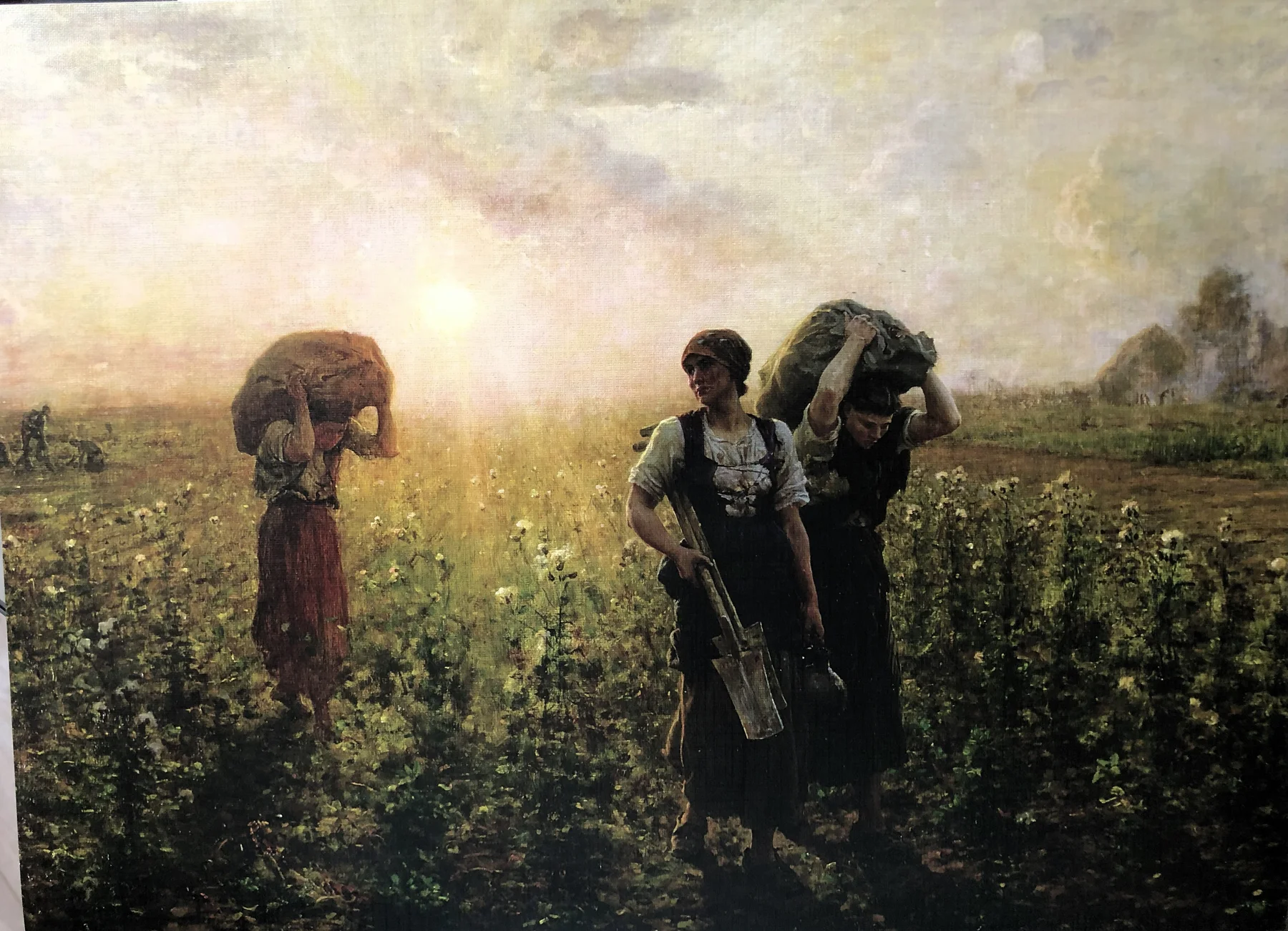
THE END OF THE WORKING DAY
Jules Adolphe Breton
- Artist
- Jules Adolphe Breton (1827–1906)
- Date
- Between 1886 and 1887
- Dimensions
- 120 x 84 cm
- Medium
- Oil on canvas
- Location
- Brooklyn Museum of Art, New York, USA
As the dim sun is about to sink below the horizon and the mist begins to rise from the fields, three potato pickers set off wearily for home in Breton’s moving painting The End of the Working Day. Two women carry heavy sacks of potatoes, while the third carries their tools and the water jug. Typically of Breton’s style, the picture shows at once the hardships of peasant life and the idyllic beauty of country life.
Village Life
Breton was born and raised in Courrières, a small village in the Artois region of northern France, the source of his lifelong attachment to the countryside. The few years of study he spent in Ghent (Belgium) and Paris in his late teens and early twenties only strengthened his affection for his native land, and from the 1850s he lived more or less continuously in Courrières.
Breton was attracted not only by the peace and harmony of the countryside but also by the traditional values of its people, their perseverance, quiet contentment, honesty and simple way of life. Whatever hardships they face, Breton’s figures are surrounded by an air of dignity, almost of heroism. The central figure of The End of the Working Day stands upright, her head held high as she looks at the fields. Like the woman to her right, she has a sculptural build, strong arms and broad shoulders. The three women are lit from behind by the light of the setting sun, which emphasises their figures even more.
An Idealised Vision
Breton’s talent showed itself above all in his ability to blend the real with the ideal. In the apt words of a contemporary critic, Armand Dayot, Breton painted “as a realist, with poetic fervour”. His landscapes perfectly convey the local features of the area, yet his figures show no sign of the malnutrition, fatigue or exhaustion that characterised peasant life in 19th-century France. He was criticised for this several times, but Breton considered himself an optimist and believed that the purpose of art was the expression of beauty.
This outlook had a strong influence on the art market and the general public of his time, and brought Breton considerable success, including the rank of Commander of the Legion of Honour awarded in 1889 and regular membership of prestigious professional juries. In an age of rapid industrialisation, his nostalgic rural landscapes showed a part of French life that was threatened with disappearance, and a piece of which eager buyers so longed for.
Fantastic Light
Early on Breton committed himself to open-air painting, which he felt brought him into closer contact with the surrounding landscape and gave him the opportunity to capture the atmosphere created by changing light conditions. The vast skies on his canvases reflected the Artois region: Breton often chose times of day — such as dawn or dusk — that showed the sky at its most beautiful. In this picture he depicted the enormous sky in the early evening light with patchy shades of pink, grey and gold. The last rays of the setting sun fade the distant horizon, including the tiny figure of the ploughman on the left and the groups of trees and farmhouses on the right. Despite the fleeting light effects, the scene nevertheless radiates a kind of pleasant permanence through the backlit figures of the three women who firmly dominate the foreground.
A Change of Title
At the 1887 Paris Salon Breton exhibited two brand-new pictures depicting potato pickers: one was the work shown here, the other the almost equally sized Across the Fields. That painting shows a group of women finishing their day’s work, who warn their companions that it is time to go home.
There is some confusion about the titles of the two pictures, since many art historians believe they were accidentally swapped by some (though not all) of the critics reporting on the Salon at the time. Strong evidence for this is one of Breton’s sketches, which shows Across the Fields, but to which the artist clearly attached the title The End of the Working Day. As a result, in the most recent comprehensive catalogue of his pictures the titles of the two paintings were swapped. The work formerly titled Across the Fields went under the hammer at Sotheby’s New York auction under its corrected title — The End of the Working Day — and sold for $585,500, while the painting discussed here, strangely, can still be seen in the Brooklyn Museum under the title The End of the Working Day.
- Armand Dayot
- Breton: The Reapers
- An example of Breton’s style
- The Brooklyn Museum of Art from the inside
- Brooklyn Museum of Art, New York