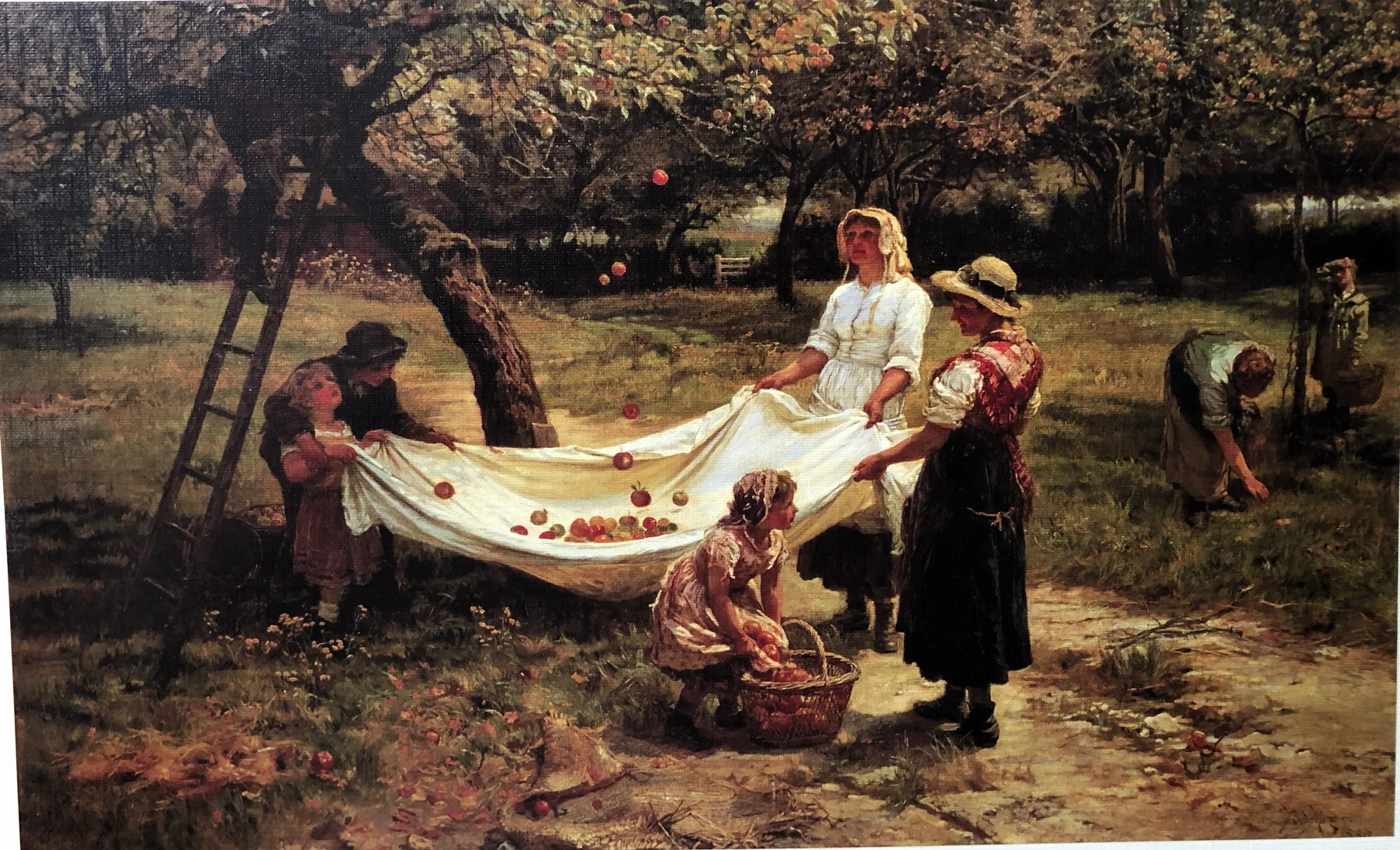
THE APPLE GATHERERS
Frederick Morgan
- Artist
- Frederick Morgan (1847–1927)
- Date
- 1880
- Dimensions
- 152.5 x 97 cm
- Medium
- Oil on canvas
- Location
- Private collection
In this picture of a peaceful rural landscape, a peasant family picks apples in an orchard suffused with dappled sunlight. Rosy-cheeked children, serene-faced women and devoted siblings appear in the picture, in a pre-industrial golden age that sentimentally celebrates family life. In the second half of the 19th century there was enormous demand for works of art depicting such nostalgic scenes of undisturbed country life — and Fred Morgan was a master of genre painting. These paintings were gladly received in the age of industrialisation because, albeit in idealised form, they satisfied the Victorian era’s longing to cling to the past.
A Fresh Style
Morgan probably painted The Apple Gatherers during a visit to Normandy, although the scene is also reminiscent of the apple orchards around Winterton in Norfolk, where the painter spent most summers with his family in the late 1800s. The influence of French plein-air (open-air) painting and of the Impressionists can be detected in Morgan’s loose brushwork and in the way he depicts the sunlight falling in patches — although it is also fairly close to the meticulously finished early Victorian paintings. Like the French artists, Morgan drew inspiration from the places he visited, and he often painted and sketched in the open air, then finished the work in his studio.
Family Man
A pleasant family life was important to Morgan, as it was to the whole of Victorian society. The Apple Gatherers depicts the simple joy of family members working together, who share the satisfaction of a job well done. Subtle touches convey the love between parent, child and siblings: in the background the mother exchanges a tender glance with her daughter, while on the left the young boy protectively embraces his little sister — the pair is perfectly framed by the arching tree trunk and the ladder. The dazzling white sheet glistening in the sunlight symbolises the togetherness of the family members.
Morgan had five children — three by his first wife, the artist Alice Mary Havers, who died in 1890 aged barely forty, and two by his second, Mary, whom he married shortly afterwards. Morgan adored his family; his wife and children often modelled for his paintings, and now and then he portrayed himself too, to complete the family picture.
Through a Photographer’s Eyes
In the late 1880s genre painting — which sought to capture the characteristic features of everyday life and showed ordinary people in their daily occupations — enjoyed extraordinary popularity, and Morgan was one of the most sought-after artists of his time. One of the reasons for his success lay in his talent for depicting facial expressions and bringing his figures to life.
In his early twenties Morgan worked for three years as a portrait painter for a photographic firm in Aylesbury. He painted family portraits for clients who wanted more than a mere photograph. This proved the perfect training ground, teaching Morgan to observe his subjects closely and to pay meticulous attention to detail. Let us take a look at the rosy-cheeked little girl on the left of The Apple Gatherers — her gaze reveals a perfect mixture of excitement, impatience and tense expectation as she looks up at the branches of the apple tree, waiting for an apple to drop. On the right the young woman is the embodiment of serene calm; her face lit by the sunlight, she watches the falling fruit almost spellbound.
Socialist Realism
Although Morgan is known mainly for his idealised portraits of village and family life, his earlier paintings tended rather towards socialist realism and depicted the hard lot of the peasantry. There are signs of this in The Apple Gatherers too, where the figures in the background show the exhausting reality of their daily work. The little girl standing on the far right raises her hand to her forehead with a weary gesture, staggering under the weight of her basket. Beside her the woman picks apples bent over, while the man at the top of the ladder leans forward and balances awkwardly as he stretches to shake the branches.
The Success of the Prints
Morgan’s charming scenes became so popular that literally thousands of reproductions of his paintings were made and sold, and the artist thus gained even greater fame. The only downside was that publishers often suggested changes they felt would improve the picture — usually recommending that one or two additional figures be painted in. Morgan did not relish this meddling, but he felt he had to comply obediently with their requests. After the printed version was published, however, he always restored the painting to its original state.
Advertising companies were quick to try to profit from his popularity. One of Morgan’s best-known pictures depicting childhood shows two small children bathing. The (undated) painting Here He Comes was made for a soap advertisement: a clearly legible bar of soap marked “PEARS” lies on the rug beside the bathtub.
- Winterton-on-Sea today
- The Dancing Bear, another genre scene by Morgan
- Here He Comes, from the Pears Annual