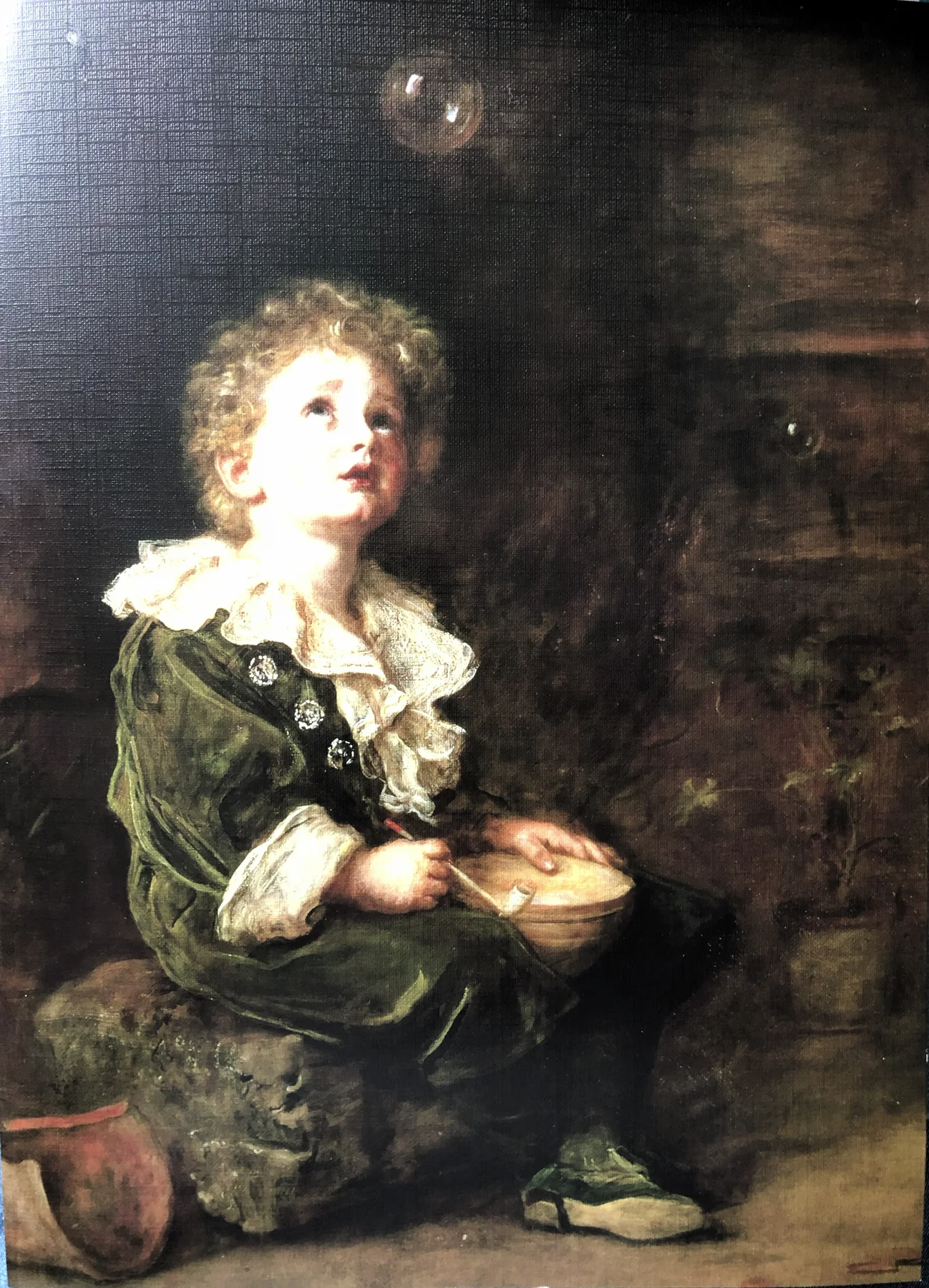
BUBBLES
John Everett Millais
- Artist
- John Everett Millais (1829–1896)
- Date
- 1886
- Dimensions
- 107.5 x 77.5 cm
- Medium
- Oil on canvas
- Location
- Lady Lever Art Gallery, National Museums Liverpool, United Kingdom (currently on loan)
John Everett Millais’ painting Bubbles is one of the most touching depictions of childhood innocence. In the picture, originally titled A Child’s World, a pretty curly-haired little boy sits alone, lost in thought, watching the bubbles rise lazily from his pipe dipped in soapsuds. His huge, shining eyes all but captivate the viewer; his sad gaze is fixed on the bubble before it bursts. The painting’s sentimentality might give some cause for mockery in today’s cynical world, yet its gentle charm brings a smile to our faces as we remember the age of innocence. Even at the time of its creation, at the end of the 19th century, the picture may have seemed old-fashioned.
A Moving Painting
After decades of artistic success, Millais was an incredibly wealthy and famous painter when he painted Bubbles in 1886. The works he made on commission from wealthy patrons made him rich, but these pictures never radiated the warmth of his paintings of children. Millais did not paint Bubbles on commission. He watched his beautiful four-year-old grandson, Willie, at play; his desire was to capture the soul of a child.
Immortal Children
Millais adored children; he and his wife, Effie, had eight children during their happy marriage. Children often appear in Millais’ best-loved paintings, such as his second daughter, Mary, in Waking (1865), and his granddaughter, Phyllis, in The Little Speedwell’s Darling Blue (1891–92). Cherry Ripe also belongs here, which, like Bubbles, became extremely popular when its reproductions went round the world’s press. In the Victorian era children symbolised purity, but because of the high child mortality of the time the picture conveyed a bittersweet mood. Millais, however, was probably trying to rival the 17th-century Dutch painters, who used bubbles to illustrate the fragility and transience of life.
The Story of Bubbles
Millais sold the painting — and, perhaps more importantly, its copyright — to William Ingram, owner of the popular and widely read newspaper the London Illustrated News, and a special colour print of Bubbles appeared in the magazine’s Christmas issue of 1887. The paper had not even appeared on the stands when the picture was bought for £2,200 by the soap manufacturer A.&F. Pears. Advertising was a new and booming industry at the time, and Pears faced serious competition on the market from Lever Brothers.
Pears wanted to associate its soaps with the idea of the purity of childhood, and a painting by a famous artist effectively raised the standard of its product advertising. Next to the bubbles, Pears Soap subsequently inserted into the picture an equally transparent soap, which was a great novelty of the age. The advertisement was a huge success, and even today, a century later, it is counted among the most famous advertising posters. Thanks to this, it became probably Millais’ best-known work.
The painting remained at the headquarters of Pears Soap for years, although the company was eventually bought in 1914 by its great rival, Lever. Bubbles can currently, and for the foreseeable future, be seen on display at the Lady Lever Art Gallery.
Controversy
Having sold the copyright of his painting, Millais could not control the fate of his work, although Pears had to agree every change with him. The artist was horrified to learn of the insertion of the soap into the picture, but was mollified on seeing the quality of the prints. The painter was fiercely attacked for having “sold himself to the advertising industry”, and feelings did not calm down even after his death. The artist and his painting are still associated with commercialism today, yet Millais merely paved the way for the host of artists who followed his example.
Using New Methods
There is something ironic in the fact that a painter so interested in the pre-industrial Middle Ages used the technology of his own time, printing presses and photography, to create and distribute his latest works. Although he did not want people to know it, Millais (and several other artists) used photographs to depict the details of his scenes, and these photographs must have been a particularly great help in capturing a fidgeting child.
We know the story of the making of Bubbles from a diary entry by a young lady, later the famous writer Beatrix Potter. In it she describes how Millais visited her father about taking a photograph, which he said he needed to help his work. Millais said he wanted to compare the photograph with reality to see what he had got wrong in his composition, and added: “you know, I cannot paint at all.”
- Beatrix Potter
- Advertisements for Pears and Lever Brothers
- Millais: Waking (1865)